Skip to content
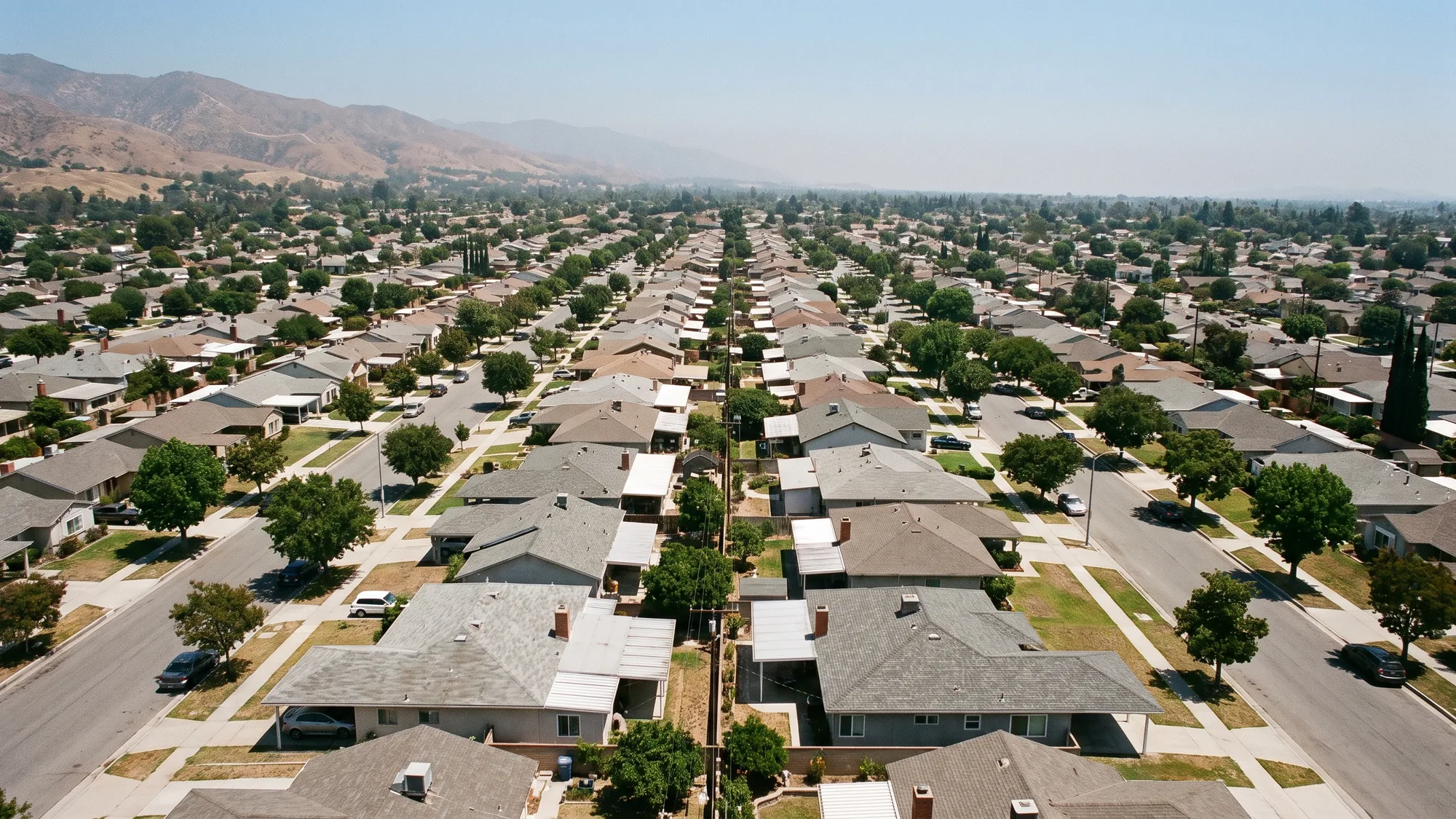
Rows of postwar San Fernando Valley houses with low-pitched composition roofs

San Fernando Valley

Roofing Contractors in the San Fernando Valley

On September 6, 2020 the National Weather Service recorded 121 degrees at Woodland Hills, the highest reading ever recorded in Los Angeles County. Heat is what uses a Valley roof up, and on most of these streets the city decides what you are allowed to put back.

Free, and there is no obligation to go ahead.

  • Free roof inspection

    Someone comes out, gets on the roof, and tells you what they find.

  • The price in writing

    A written quote before anyone starts, with nothing to sign on the day.

  • Licensed roofers

    The roofer who turns up holds a current California license.

  • Across Los Angeles County

    From the Valley and the foothills to the Westside and the South Bay.

The San Fernando Valley is mostly City of Los Angeles. Where it is not, it is Burbank, Glendale, Calabasas, Hidden Hills or the small independent City of San Fernando, and each of those runs its own building counter. The Valley is also the hot end of the county. Both of those facts land on a roofing quote here.

  • Housing stockPostwar tracts on low-pitched composition, most on a second covering, with a flat addition on the side
  • Permit authorityLADBS for most of it; Burbank, Glendale, Calabasas, Hidden Hills and San Fernando issue their own
  • Typical hereComp re-roof $9,000 to $25,000
  • Worth knowingOff the mapped rim the code floor is Class C: ask what the assembly is actually listed at

What the Valley's housing means for your roof

Most of the floor was built once, quickly, in the twenty years after the war. Panorama City is the clearest case. The Los Angeles Conservancy records that Fritz Burns and Associates developed it in the late 1940s for Kaiser Homes, owned by Henry J. Kaiser, on a master plan calling for over 4,000 houses, with components pre-milled at a factory near LAX, and a population of 20,000 by the early 1950s. Ranch and Minimal Traditional, single story, low-pitched gable and hip roofs running long and plain. Van Nuys, Reseda, Canoga Park, Arleta, North Hills and Winnetka repeat that street after street, and the median year built for City of Los Angeles housing is 1965 in American Community Survey table B25037, so most of these houses are on a second or third covering.

What all of it has in common is a lot of roof pointed straight up at the sun. NASA's ECOSTRESS instrument measured peak land surface temperature in the San Fernando Valley at 128.3 degrees on August 14, 2020. That is the number the covering lives at, not the air temperature on the news. Asphalt shingle ages by heat here more than by rain: granules let go, the mat goes brittle, corners curl, and the sealant strip that holds the tabs down softens every summer until it stops re-sealing. The attic below runs hotter again, and on most of these tracts the heating and air ducts are up there in it. A re-roof is when the vents get cut, so it is the one moment ventilation gets sized properly.

The second Valley pattern is the low-slope piece bolted onto a pitched house. Patio covers, carports, converted garages, the den added across the back in 1968, the occasional flat-roofed contemporary. Those sections are a separate trade from the shingle above them, and they are where ponding, split seams and a tired cap sheet turn up. They also carry a stricter reflectance number than the pitched part of the same roof, which is worth knowing before anyone quotes you a black cap sheet. A coating is a reasonable answer on a sound low-slope deck and a poor one on a wet deck.

Then there is the 1990s. The Northridge earthquake hit the middle of the Valley at magnitude 6.7 on January 17, 1994, and the US Geological Survey puts the property damage at about $40 billion. A great deal of Valley housing was repaired and re-covered in the years that followed, and a shingle sold as a thirty-year product in 1996 has run its number out. Nothing dramatic has to happen for it to start letting water in. More of that is on the roof replacement page.

Sun-bleached composition shingle meeting the low-slope cap sheet of an attached patio cover
The seam where a pitched shingle roof meets an attached low-slope section. On a Valley tract that flat deck carries a stricter reflectance requirement than the shingle above it.

What you are allowed to put back

Wood is out. Los Angeles Building Code Section 1505.1 says no wood shake or wood shingle roof covering is permitted anywhere in the city, following City Roofing Ordinance 165047, effective August 25, 1989.

Fire class depends on the parcel. Section 1505.1.1 asks for a covering of at least Class A in a fire hazard severity zone. Section 1505.1.2 asks for at least Class C everywhere else in the city. Both reach any roof covering applied in the alteration, repair or replacement of an existing roof, and the whole roof once more than 50 percent of the total roof area is replaced within any one year period. On a flat Valley lot with no zone on it, Class C is the code floor, so ask what the assembly is actually listed at before you pay anyone for an upgrade. Inside the zones the rating belongs to the whole listed assembly, and the underlayment is part of it. The Department of Building and Safety's own plan check list for the Wildland-Urban Interface Code asks for a roof assembly that complies with a Class A classification tested to ASTM E108 or UL 790, and for underlayment tested as part of that assembly.

The cool roof rule is the one that catches people. Ordinance 187208 rewrote Section 99.04.106.5 of the Los Angeles Green Building Code, and its low-rise table asks a steep-slope residential roof for a three year aged solar reflectance of 0.25 with thermal emittance of 0.85, or an SRI of 20, and a low-slope roof for 0.65 and 0.85, or an SRI of 78. The exception is roof replacement where the area being replaced is equal to or less than 50 percent of the total roof area, so half the roof area is the line between a repair and a full code re-roof in this city.

The state energy code runs on top of that, in the city and outside it, and it works by climate zone. The California Energy Commission's climate zone list by ZIP code puts Van Nuys, Woodland Hills, Calabasas and San Fernando all in building climate zone 9. The Cool Roof Rating Council's summary of the 2025 Energy Code, in effect since January 1, 2026, reads Title 24 Section 150.2(b)1 as asking a re-roofed single family house in zone 9 for 0.20 aged solar reflectance and 0.75 emittance on a steep slope, and 0.63 and 0.75 on a low slope. R-38 ceiling insulation, an attic radiant barrier, and a house with no ducts in the attic each count as equivalent to the steep slope number in this zone. Ask which code edition your quote was written to.

Which counter your address permits at

Most Valley addresses are City of Los Angeles, so the permit is LADBS, and the Valley office is the Development Services Center at 6262 Van Nuys Boulevard, second floor, room 251, which does express permits, counter plan check and inspection. Burbank runs its own Building and Safety Division under Community Development and added re-roofing to its online permits. Calabasas at the west end runs its own Building and Safety Division, which reviews plans, issues permits and inspects. Hidden Hills issues its own permits through a building department it contracts out. Glendale has its own department over the Verdugo line, covered on the Glendale page.

The one that trips people up shares the name. The City of San Fernando is an independent city of about two and a third square miles at the north end, completely surrounded by the City of Los Angeles, with its own Building and Safety Division at City Hall on Macneil Street, which reviews all construction plans and inspects all permitted construction inside the city limits. A house there permits at that counter. A house a few blocks away in Sylmar or Pacoima permits at Van Nuys. The San Fernando Valley and the City of San Fernando are two different jurisdictions, and only one of them has a city hall. Universal City is a third case, unincorporated Los Angeles County, so a job there permits through LA County Public Works and not LADBS, even though city surrounds it on all but its northeastern corner, which touches Burbank. Pulling the permit is our job and not yours, but it is worth knowing which office your job is sitting in.

The fire zone sits on the rim

Most of the Valley floor carries no fire hazard severity zone at all. The edges are a different answer: the Santa Susana Mountains and the northern foothills above Sylmar, Granada Hills, Porter Ranch and Chatsworth, and the Santa Monica Mountains flank along the whole south side, from Woodland Hills through Encino and Sherman Oaks to Studio City.

That line moved. CAL FIRE issued the recommended Local Responsibility Area maps for Southern California on March 24, 2025, and for the first time they carry moderate and high inside city fire department territory alongside very high. On the recommended state map, very high now reaches north of Ventura Boulevard in some parts of the Valley. The requirement follows both of the top two zones. The California Wildland-Urban Interface Code, which took over from Chapter 7A of the Building Code on January 1, 2026, applies on any parcel mapped high or very high, and on every parcel in a state responsibility area whatever zone it carries. The city's plan check list for that code says the same thing at CWUIC 101.3.1, and what it asks for on the roof is a Class A assembly, ember resistant vents listed by the State Fire Marshal or tested to ASTM E2886, and noncombustible gutters with an approved way of keeping debris out of them.

Check your own address before you accept a quote, and ask which map the answer came from. The Los Angeles Fire Department's April 2025 notice on the maps says it is aligning them to city streets and property lines, with public review and an adoption ordinance to follow. Its fire zone page still tells residents to check the State of California map. Two maps are in play on the same street.

What roof work costs in the San Fernando Valley

Estimate ranges for Los Angeles County, not quotes.

  • Small repair(slipped shingles, resealing a vent, clearing a drain): roughly $400 to $900.
  • Single-source leak(chimney or skylight flashing, a localized shingle repair, a flat-roof seam): roughly $800 to $2,500.
  • Composition shingle replacement:roughly $9,000 to $25,000.
  • Flat or low-slope (TPO, modified bitumen, cap sheet):roughly $12,000 to $30,000.
  • Tile lift and relay,where a house has tile: roughly $12,000 to $30,000.
  • Solar panel removal and reinstall:roughly $4,000 to $10,000, on top of the roof itself.

The Valley floor sits in the lower half of the shingle range more often than the hillsides do. One story, plain gable and hip shapes, a driveway or an alley for the bin, and no fire assembly to build underneath. What moves a floor quote up is the low-slope section on the side of the house, and a deck that turns out to be soft once the covering is off. What moves a hillside quote up is access and the zone. The roofing costs page breaks the rest of it down.

Common questions about roofing in the San Fernando Valley

Is my Valley address in a fire hazard severity zone?

If you are on the floor, probably not. If you are on the northern foothills or anywhere on the Santa Monica Mountains side, quite possibly. CAL FIRE issued the recommended maps for Southern California on March 24, 2025, and they added moderate and high inside local fire department territory for the first time, which is why the answer changed for parcels that used to read as nothing. On that recommended map, very high now reaches north of Ventura Boulevard in some parts of the Valley. High and very high both bring the Wildland-Urban Interface Code in, and with it a Class A assembly, ember resistant vents and noncombustible gutters. Moderate on its own does not. Check the address on the state fire marshal's viewer, then ask the permit counter which map it is working from.

Why does my roofer keep talking about reflectance?

Because in this city it is on the permit. The Green Building Code asks a steep-slope residential roof for a three year aged solar reflectance of 0.25 with thermal emittance of 0.85, or an SRI of 20, and a low-slope roof for 0.65 and 0.85, or an SRI of 78, once you replace more than half the roof area. The low-slope number is far higher than the steep-slope one, which is why a Valley patio or garage deck usually comes back light. The rating is proved on paper: the 2025 Energy Code makes a roofing product used to meet these rules carry a label listing its emittance and its initial and three year aged solar reflectance, and be rated by the Cool Roof Rating Council. Ask for the product name and the CRRC rating in the written quote, so it can be checked before material is ordered.

My roof is only a few years old. Why is the upstairs still unbearable?

Usually the attic, not the covering. On a Valley tract the ducts run through an attic sitting under a surface ECOSTRESS clocked at 128.3 degrees in August 2020, and if the intake at the eave is blocked or was never big enough, the hot air has nowhere to leave. Net free area at the eave is the part that gets missed, because the exhaust up top is easy to see and the intake underneath is not. The 2025 Energy Code also counts R-38 ceiling insulation or an attic radiant barrier as equivalent to the steep slope reflectance number on a re-roof, so it is worth pricing the attic work at the same time as the roof, while the covering is off and the vents can be cut properly.

Tell us the address and what is happening up there: tell us what's going on. Next door we cover Glendale over the Verdugo line and the Hollywood Hills on the other side of the crest.

The offer

$500 off a new roof, 10% off any repair

Start online and it is attached to your request, with nothing to remember.

  • We get on the roof, and into the attic if that is where the answer is
  • You get photographs of whatever we find
  • The price in writing, with nothing to sign on the day
Claim it on a free inspection

Tell us what is going on

A description is enough to start. We will come out, look at the roof properly, and give you the price in writing.

Get a free quoteTell us what the roof is doing. It takes a minute.

Tell us about the job

If water is coming in right now, say so here.

Add a street address

or call (310) 857-2520

The ridge of a residential roof with ridge cap shingles over a ridge vent

Before you go

$500 off a new roof, 10% off any repair

Start here and it is attached to your request, with nothing to remember. The inspection is free either way.

  • We get on the roof, and into the attic if that is where the answer is
  • You get photographs of whatever we find
  • The price in writing, with nothing to sign on the day
Claim it on a free inspection
Call (310) 857-2520Get a free quote