Studio City
Roofing Contractors in Studio City
Studio City has no building department of its own, so every roof permit comes from LA Building and Safety. What the permit asks for turns on a fire map, and two of them are in play: the one the city adopted by ordinance and the one CAL FIRE recommended in 2025. They agree about the hillside. They part company on the blocks just north of Ventura Boulevard.
Free, and there is no obligation to go ahead.
- Free roof inspection
Someone comes out, gets on the roof, and tells you what they find.
- The price in writing
A written quote before anyone starts, with nothing to sign on the day.
- Licensed roofers
The roofer who turns up holds a current California license.
- Across Los Angeles County
From the Valley and the foothills to the Westside and the South Bay.
Ventura Boulevard splits the neighborhood and it splits the roofing work. SurveyLA draws the same line: north of the boulevard the ground is flat with a rectilinear street grid, and south of it the survey area begins to ascend the foothills of the Santa Monica Mountains. Studio City runs from Lankershim Boulevard on the east to Coldwater Canyon Boulevard on the west, and climbs from the boulevard to Mulholland Drive.
- Housing stockPeriod revival and barrel tile south of Ventura, near-flat hillside houses up to Mulholland
- Permit authorityLADBS. Under 6 lb per square foot and Class A or B is an express permit
- Typical hereTile relay $12,000 to $30,000
- Worth knowingThe city map and CAL FIRE's 2025 map draw different lines here; both pull the wildland code in
What Studio City's housing means for your roof
The old stock sits on the flat ground just south of the boulevard. Laurel Terrace, the twelve blocks between the boulevard and the toe of the hill, was one of the earliest neighborhoods here: subdivided in 1923 and 1924 by an Iowa cattle breeder named David Maxwell, built out through 1953, and surveyed by the city as 328 properties with 185 still reading as original. Spanish Colonial and American Colonial period revival, with Minimal Traditional and Ranch alongside them.
On the Spanish houses the barrel tile outlasts nearly everything and the felt under it does not, so a roof that looks fine from the street can be wetting a ceiling. The answer there is usually a lift and relay: sound tile off, new underlayment, the same tile back down. The tracts that filled in around it after the war brought low pitches instead. Between two in twelve and four in twelve the LA Residential Code calls for doubled underlayment. Leave it single and the roof looks right for years, then lets go on the first storm that drives rain uphill under the tabs.
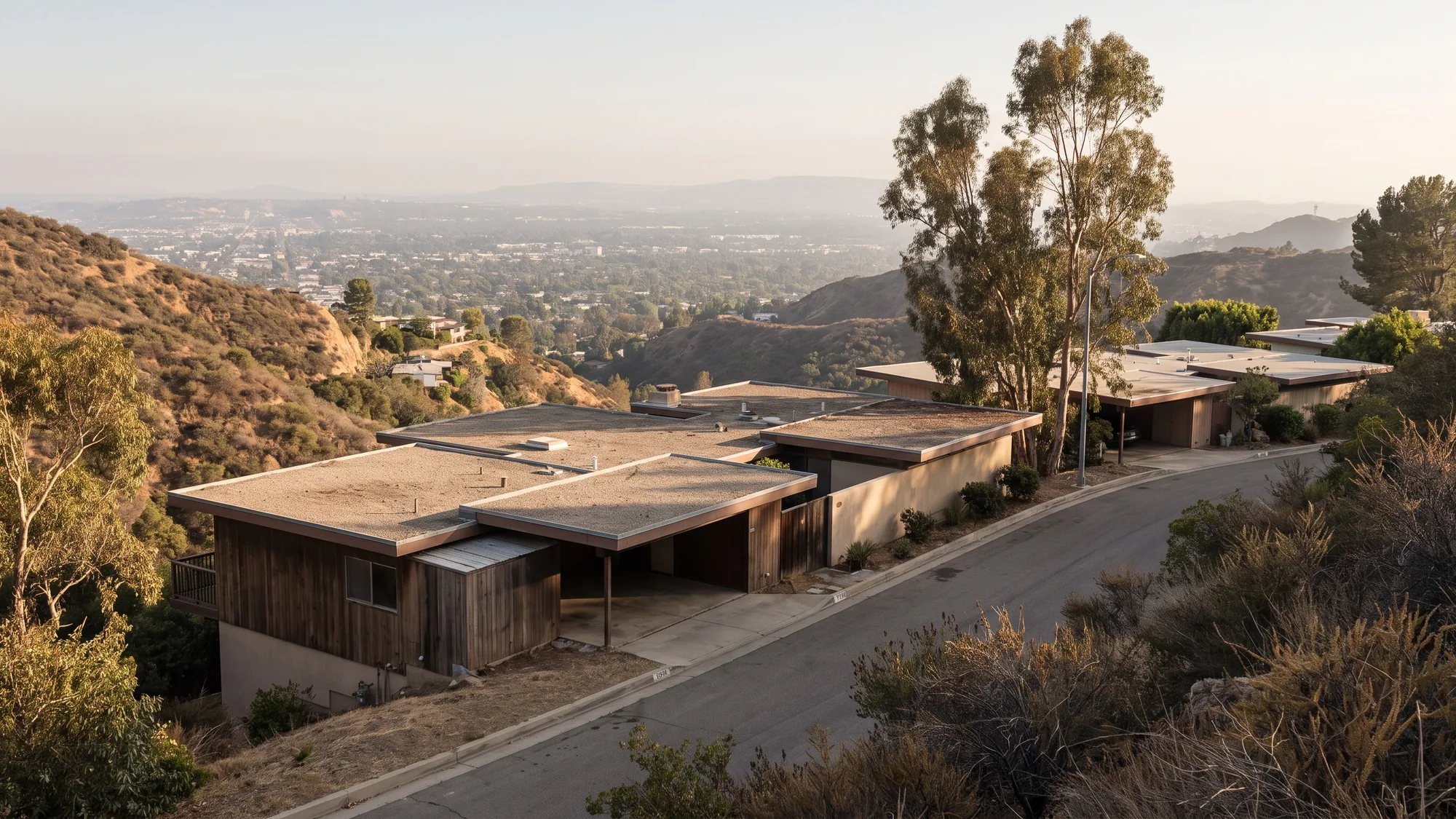
South of Laurel Terrace the ground climbs to Mulholland Drive and the houses change with it. Briarcliff Manor premiered in 1939 as the Beverly Hills of the Valley, its first tract laid out along Iredell Street at Fryman Road on former ranch land, and its streets still curve with no sidewalks. Eureka Summit came later, fourteen houses at the south end of Wrightwood Drive built between 1961 and 1963, set flush with the street and turned away from the road to face the canyon. On that generation of hillside house we find roofs running flat or close to it, with the deck doubling as the finished ceiling. No attic catches anything, so water comes through onto the wood you are looking at.
Nothing in Studio City is a Historic Preservation Overlay Zone. City Planning's HPOZ map returns nothing across the whole neighborhood, so those survey districts carry no design review and no board rules your roof color. The top of the hill is the one place with an extra layer. Where Studio City meets Mulholland Drive the parcels sit inside the Mulholland Scenic Parkway Specific Plan, whose design guidelines ask that visible roof coverings be non-reflective earth tones. Those guidelines bite on projects that go through design review under the plan, not on a like-for-like re-roof. Permits come from LA Building and Safety either way, online as an express re-roof permit or by appointment at the Van Nuys Development Services Center, 6262 Van Nuys Boulevard, Room 251. More is on the roof repair and roof replacement pages.

What roof work costs in Studio City
Estimate ranges for Los Angeles County, not quotes.
- Small repair(slipped tiles, resealing a vent, clearing a drain): roughly $400 to $900.
- Single-source leak(chimney or skylight flashing, a localized shingle repair, a flat-roof seam): roughly $800 to $2,500.
- Sectional lift and relay(one slope, or the one area that keeps leaking): roughly $2,500 to $7,000.
- Composition shingle replacement:roughly $9,000 to $25,000.
- Tile lift and relay, whole roof:roughly $12,000 to $30,000.
- New tile throughout:roughly $25,000 to $60,000.
- Flat or low-slope (TPO, modified bitumen, cap sheet):roughly $12,000 to $30,000.
- Solar panel removal and reinstall:roughly $4,000 to $10,000, on top of the roof itself.
A few things in Studio City push a job toward the top of those ranges. Hillside streets are narrow and often have no driveway, so tear-off gets carried up a stair instead of dropped in a bin at the door. Flat and low-slope roofs take more material under the surface than a plain gable. And on a parcel the map calls high or very high, the assembly under the covering costs more. The roofing costs page breaks that down. Work on the commercial buildings along Ventura Boulevard is on the commercial roofing page.
Common questions about roofing in Studio City
Which fire map applies to my Studio City address?
Ask, because two maps are in play: the one the city has adopted and the one it has not. The adopted Very High zone is the map named in Los Angeles Municipal Code Section 57.4911.1.1, which points at the most current map adopted by ordinance. It covers the hillside, runs up to Ventura Boulevard, and at the Coldwater Canyon end crosses the boulevard onto Valleyheart Drive. The 12000 and 12400 blocks of Ventura sit inside it, and so does Laurel Terrace Drive. That is the zone the express re-roof permit is written against today, and that section names no High or Moderate zone at all.
CAL FIRE issued recommended local responsibility area maps for Southern California on March 24, 2025, and those carry the hazard north of the boulevard. How far north depends on where you stand. Near Radford Avenue, LA County's 2025 layer reads Very High for a block past Ventura, High for two blocks after that, then a thin band of Moderate, and Moorpark Street is out of the wildland classes. At the Coldwater Canyon end the Very High reaches past Valley Spring Lane as far as Woodbridge Street. Toward Lankershim the map is already out of the wildland classes at Valley Spring. State law requires the city to adopt the recommended maps by ordinance, and in April 2025 LAFD said it was aligning the state boundaries to city streets and property lines first.
The California Wildland-Urban Interface Code replaced Chapter 7A of the Building Code on January 1, 2026. Section 101.3.1 applies it to any parcel mapped high or very high. No part of Studio City sits in a state responsibility area, so the mapped class is the whole test here. A Class A tested assembly, ember-resistant vents and non-combustible gutters come with it. LADBS reads the zone off local and state maps together. Its Fire Hazard Severity Zone Supplemental Checklist, document PC/STR/Corr.Lst.116, effective January 1, 2026 and revised March 27, 2026, applies the code to a building in a Very High or High zone shown on either one, so a High reading on the state map north of the boulevard can pull the code in even though the city has not adopted that map. The express re-roof permit is the narrower document and ties Class A to the adopted Very High zone alone. Ask which zone your address carries on both maps, and which one the quote was priced against.
Does the cool roof rule apply to my re-roof?
If you are replacing more than half the roof, yes. The LADBS express permit bulletin, document P/GI 2026-003, effective January 1, 2026 and revised June 10, 2026, calls for a cool roof product labeled and certified by the Cool Roof Rating Council on any residential roof replacement over 50 percent of the total roof area. One job is written out of the rule. The same bulletin carries "remove existing roof tiles, apply new underlayment and reset roof tiles" as its own line, with cool roof compliance not required. If your tile is sound, the lift and relay keeps you clear of it.
My house still has wood shingles. Can I put them back?
No. The LA Residential Code says no wood shake or shingle roof covering is permitted, citing LAMC Subsection 1505.1, and that ban runs citywide with no fire zone attached to it. The class rules sit on top. In a mapped fire hazard severity zone the covering has to be Class A, everywhere else in the city Class C is the floor, and both apply to the whole roof once you replace more than 50 percent of the area inside any one-year period. That catches people planning a half now, half later job. The zone LADBS writes into the express re-roof permit is the Very High one. The rating belongs to the tested assembly, the deck and underlayment and covering together, so ask which assembly is quoted.
Tell us the address and what is happening up there: tell us what's going on. We also cover the Hollywood Hills, over the ridge from Mulholland.
The offer
$500 off a new roof, 10% off any repair
Start online and it is attached to your request, with nothing to remember.
- We get on the roof, and into the attic if that is where the answer is
- You get photographs of whatever we find
- The price in writing, with nothing to sign on the day
Tell us what is going on
A description is enough to start. We will come out, look at the roof properly, and give you the price in writing.