LA Roof Experts(310) 592-2048Licensed LA roofers, matched to your job

Find a Licensed Roofing Contractor in the Hollywood Hills

Up here the roof usually isn't the hard part — getting it up the hill and the old one back down is. Tell us what's going on and we'll match you with one licensed, insured roofing contractor who works the Hollywood Hills. Free inspection, written quote, no obligation.

Almost every roof gets priced by what's on it. Up here it gets priced by where it is. Same composition roof, same number of squares, same crew: on a flat street in the Valley it's one number, and on a switchback off Laurel Canyon it's another. That isn't a markup for the view. It's the cost of getting new material up to the house and the old roof back down to a truck.

How we match you with a Hollywood Hills roofer

So there's no confusion about who you're talking to: we're not a roofing company. We hold no contractor's licence and we do no roofing work. We find you someone who does, and check them before your details go anywhere.

Tell us the address, the roof type if you know it, and anything you know about access — how many steps, whether a truck can stop outside, whether the driveway is shared. We match you with one licensed, insured roofing contractor who works the hills, not a list, and not five companies ringing you all week. You get their CSLB licence number before they arrive so you can look it up yourself. They come out, get on the roof, and give you a written quote, free and with no obligation. If they're not the right fit, say so and we'll re-match you at no cost.

Beyond the licence we filter for two things: real low-slope and flat-roof experience, because so much of the stock up here has almost no pitch, and a contractor who actually works hillside streets. A roofer who spends every week in the flats will quote this like a flats job and meet the access on day one — and you'll meet it as a change order.

What the hills' housing stock means for your roof

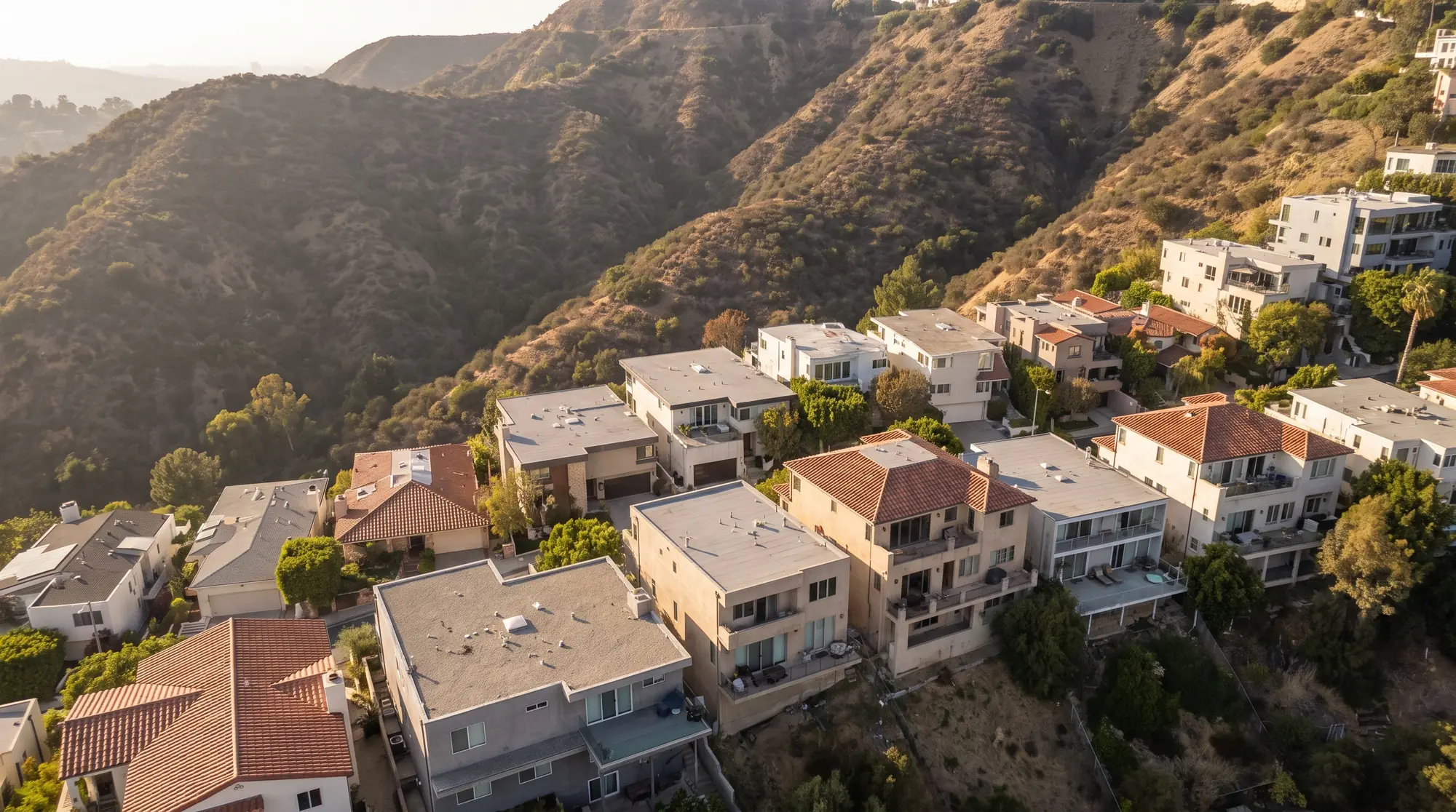
The mid-century hillside houses. Post-and-beam and hillside modern from the 1950s through the 1970s, cantilevered over the slope on Mount Olympus, the Bird Streets, the lots off Mulholland and up Nichols Canyon. Low-slope or dead-flat roofs — cap sheet, modified bitumen, TPO where they've been redone — over exposed beam ceilings. No attic, no crawl space, so no ventilation and nowhere to inspect from: nobody can crawl up and trace a leak back to its source. Water that gets in shows up on your living-room ceiling that afternoon, often a long way from where it entered. Ponding, split seams, failed parapet and scupper flashings and tired skylight curbs are the recurring failures here.

The older canyon stock. Beachwood Canyon and Whitley Heights hold 1920s Spanish and storybook houses — low-pitched clay tile, deep eaves, fiddly rooflines with more valleys and flashing per square foot than anything built since. Outpost Estates runs to steeper tile. On all of it the tile is usually fine and the underlayment is not: tile lasts fifty years or more, the felt beneath it rarely past twenty-five or thirty.

And it's all old enough to matter. LA County's median home was built in 1965. A thirty-year shingle laid in 1994 is finished, and a cap sheet from that era has taken thirty summers of UV. Most houses up here are on their second roof and plenty are due a third.

Roofing work commonly needed in the Hollywood Hills

There's more on each of those on the roof repair and roof replacement pages.

Getting the material up and the old roof down

Much of the hills is served by what the city calls a Substandard Hillside Limited Street — a street whose dedicated width is under 36 feet or whose paved roadway is under 28 feet, under LAMC Sec. 12.03, added by the Baseline Hillside Ordinance (Ord. No. 181624, 2011). In practice the Bureau of Engineering makes the call on the paved roadway width: under 28 feet of pavement and the street is substandard, whatever the dedication says. The classification itself governs new construction and additions, not re-roofs; where it bites on a roofing job is access. It's the kind of road where a parked car and a delivery truck can't pass each other. Add blind curves, shared and private driveways, and houses that sit a full storey below the road with the roof at your feet, or a hundred steps above it with no vehicle access at all.

The ordinary mechanics of a re-roof stop working there. On a flat lot the tear-off goes down a chute into a bin on the driveway and new material gets boomed onto the roof off the truck. Up here there may be no driveway for a bin and no legal place on the street to leave one. The tear-off gets carried down by hand, run down a conveyor, or in the harder cases lifted off by crane, and material goes up the same way. Some jobs need traffic control or a short street closure just so the truck can stand still, and preferential parking districts and street sweeping days decide which hours a crew can stage at all.

None of that is reason to be suspicious of a higher quote. It's reason to settle access before anyone signs. Ask the contractor to walk the access with you, not just the roof, and get two things in writing: how the tear-off leaves the site, and where the truck and the bin will sit. That's where surprise change orders come from, and it's an easy question on the first visit.

What roof work costs in the Hollywood Hills

These are estimate ranges for Los Angeles County, not quotes. Nobody can price a roof without standing on it.

Expect the hills at the top of those ranges rather than the middle. The roofing costs page lists what pushes any LA job to the top end — extra layers to tear off, soft decking, a cut-up roof, a hillside street where everything gets carried — and up here you often have several at once. Chapter 7A detailing adds cost at every eave, vent and penetration on top. Scheduling is easier from late spring through early autumn; rain season is October to March, when every good roofer up here is booked and working leaks.

Permits and code in the Hollywood Hills

You're in the City of Los Angeles, so your permitting authority is LADBS — not Glendale, not Burbank, not West Hollywood, all of which run their own departments a few minutes' drive away. A re-roof needs a permit. For a like-for-like replacement it's an express permit with no plan check, a lighter process than people expect.

Worth being clear about something hillside owners worry over. The city's heavy hillside machinery — the Baseline Hillside Ordinance, the Hillside Construction Regulation districts, haul route approval — is aimed at grading, height, floor area and moving earth, and haul route approval turns on 1,000 cubic yards or more of soil. Replacing a roof does none of that. It works the other way round: the same streets that made those rules necessary are the streets your crew has to work on.

The rule that does bite is fire. Laurel Canyon, Nichols Canyon, Beachwood, Outpost, Runyon, Cahuenga Pass and the Mulholland corridor sit in a Very High Fire Hazard Severity Zone, and CAL FIRE's updated Southern California maps landed on 24 March 2025. That brings Chapter 7A of the California Building Code into your re-roof. People get this wrong by assuming a Class A shingle equals compliance. Chapter 7A requires a Class A assembly — deck, underlayment, cap sheet, covering, and how the eaves, valleys, ridges and penetrations are detailed. Ask for the assembly listing, not the shingle's rating.

Eave detailing deserves particular attention here, because so many of these houses have deep cantilevered overhangs with open rafter tails — exactly the geometry that catches embers and holds them. Ember-resistant attic and eave vents and non-combustible gutters usually matter more in a real ember storm than what the covering is made of.

Your matched contractor's licence

Every contractor we match you with holds a current CSLB licence — a C-39 roofing licence, or a B general building licence where the roof sits inside a larger job — with liability insurance and workers' compensation on file or a valid exemption. We check active status, classification, bond and insurance before your details go over, and you get the licence number up front so you can verify it on the state register in about a minute.

To be clear about who is who: your contract is with the roofing contractor. The work, any workmanship guarantee and any manufacturer's material warranty come from them, not from us.

Common questions about roofing in the Hollywood Hills

Why is my quote higher than the same roof down in the flats?

Access, almost always. If the tear-off has to be carried or conveyed instead of chuted into a bin, if the truck needs traffic control to stand still, or if a crane is the only way material reaches the deck, that's real labor and real equipment. Ask for it broken out on the quote so you can see what you're paying for.

My ceiling is the roof. There's no attic. How does anyone find the leak?

Slowly and from above. With no attic to inspect from, the roofer works the surface — seams, flashings, curbs, penetrations, drains — often running water on the roof in sections to isolate it. Expect that to take longer than on a pitched roof with a crawl space, and be wary of anyone who names the cause from the driveway.

Do I need a haul route approval to re-roof?

No. Haul routes are about moving earth in quantity — 1,000 cubic yards or more — which is a grading matter. A re-roof is an ordinary LADBS re-roof permit. Your street affects how the crew works, not which permit you pull.

Is my house in a Very High Fire Hazard Severity Zone?

Most of the hills is, but it's parcel by parcel and the maps were updated in March 2025, so check yours rather than assuming. It changes what you're allowed to put on the roof — an assembly priced for the fire zone and one that isn't are not comparable numbers.

My tiles look perfect. Why would the roof need doing?

Because tile outlives the underlayment beneath it by decades. Tile roofs here almost always fail underneath, and lift and relay reuses your existing tiles while replacing the layer that actually keeps water out.

Tell us what's going on with your roof and we'll match you with one licensed roofer who works the hills — start here. Nearby: Hancock Park and Glendale.

Call now — (310) 592-2048