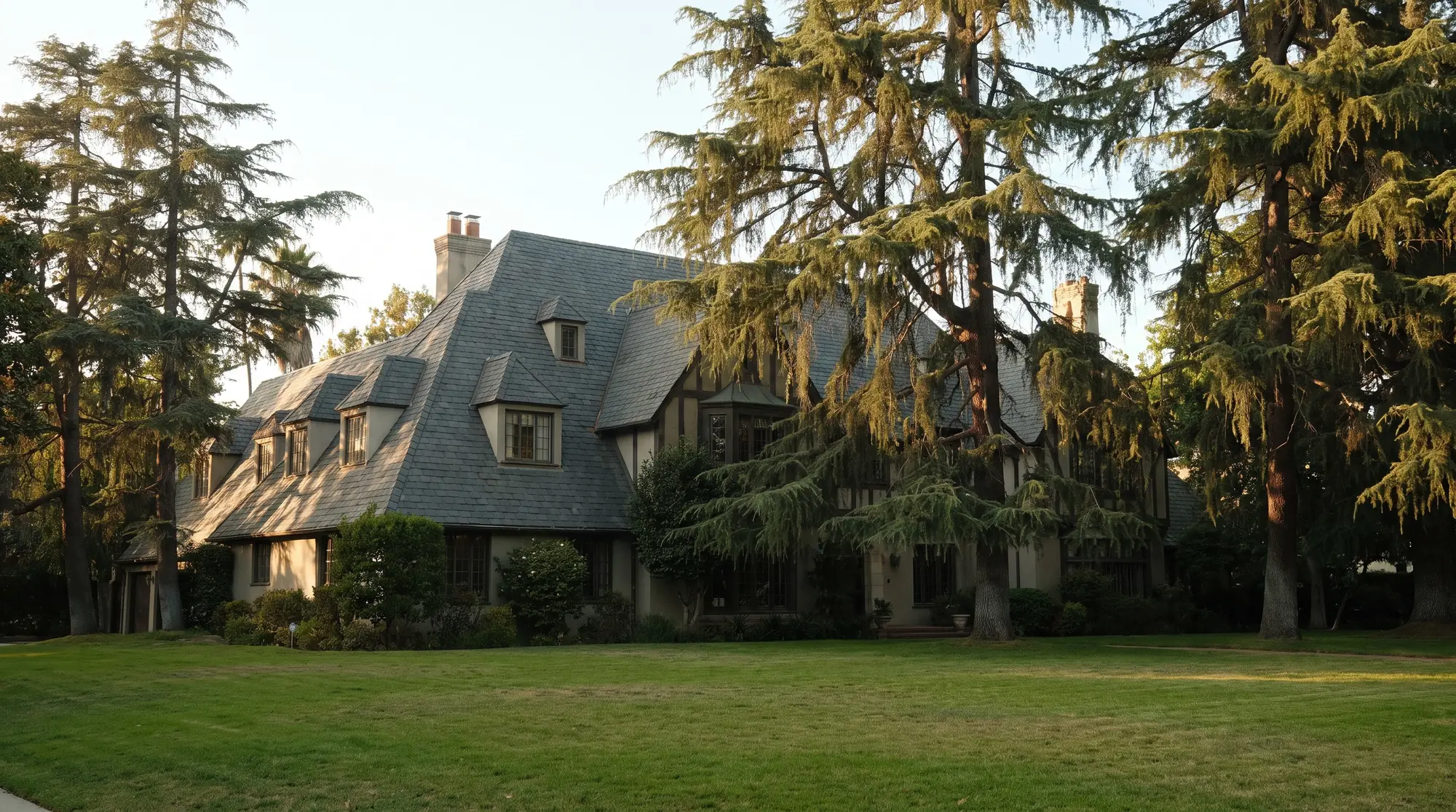
Hancock Park is a Historic Preservation Overlay Zone, and that changes the order in which a roofing job happens here. On a contributing house, altering the roofline or the visible roof material has to clear historic review under the adopted Hancock Park Preservation Plan before LADBS will move the re-roof permit. Historic review first, building permit second. A roofer who has never worked inside an HPOZ tends to find that out after they've already given you a start date.
How we match you with a Hancock Park roofer
We're not a roofing company. We hold no contractor's licence and we do no roofing work. We find you someone who does, and check them before your details go anywhere.
Tell us the address, what the roof is made of if you know, and what's going on — a leak, a tile roof you're tired of patching, a roof somebody has told you is finished. We match you with one licensed, insured roofing contractor who works these streets. Not a list, not five companies calling at dinner. You get their CSLB licence number before they arrive, so you can check it on the state register yourself. They come out, get on the roof properly, and give you a written quote. Free, no obligation. If they're not the right fit, we'll re-match you at no cost.
Here we look for contractors who handle clay tile as clay tile rather than as something to strip and shingle over, and who have been through an HPOZ submission before. The contract, the work and any guarantee belong to the contractor, not to us.
What Hancock Park's housing stock means for your roof
The HPOZ runs from Melrose Avenue down to Wilshire Boulevard, and from both sides of Rossmore Avenue across to both sides of Highland Avenue. Building started on Rossmore in 1920 and moved west toward Highland, and the streets that curve around the Wilshire Country Club — Hudson Avenue, Hudson Place, June Street, Las Palmas Avenue, McCadden Place — are a rare break from the LA grid. The period of significance is 1920 to 1956, and most of these houses went up in the 1920s and 1930s: Tudor Revival, English Revival, Spanish Colonial Revival and Mediterranean Revival, with Monterey, American Colonial and French Eclectic scattered through. That puts two very different roofs on the same block.
- Low-pitched clay tile on the Spanish and Mediterranean houses — terra-cotta barrel and flat profile, laid in the 1920s and still shedding water ninety years later.
- Steep, cut-up rooflines on the English and French houses: clipped gables, turrets, dormers, deep valleys, multiple chimneys, and here and there built-up roofing imitating thatch.
- Specialty historic roofing on the houses that have it. The Preservation Plan groups tile, slate and built-up shingle together as historic specialty materials, to be preserved in place or replaced in kind wherever they still exist.
- Composition shingle and simulated wood shake where the original wood shingle has gone. The code no longer allows shake to be replaced in kind, so simulated shake is the accepted substitute.
The tile rule applies here with more force than anywhere, because the houses are older. Tile lasts fifty years or more; the underlayment beneath it rarely gets past twenty-five or thirty. A 1920s tile roof here is on its third or fourth layer of felt, and the tile can be sound while the waterproofing underneath has turned to powder. That's why a roof here leaks badly and looks immaculate from the street. More on the roof repair page.
Specialty roofing is a different trade
If your house has slate, clay tile or built-up shingle, the Preservation Plan treats it as historic specialty roofing: keep it in place, or replace it in kind. How rare the material is doesn't change the rule. Keeping it is also the quicker path through review, because renewing a roof in the same material counts as ordinary maintenance, repair and in-kind replacement — staff level, no Board hearing.
These materials rarely fail at the material itself. Slate outlives the people who laid it, and 1920s clay tile is often still sound. What fails is the fixings and the flashings: nails corrode, pieces slip, and the metal in the valleys and around the chimneys goes first. The right repair is usually to re-fix what has failed and renew the metal, not to strip the roof. A contractor who treats slate or tile like composition shingle will wreck it — walked the wrong way, a slate roof loses slates that had another fifty years in them, and each one then has to be sourced and matched. If a roofer quotes on specialty material without asking about the fixings or the flashing metal, get a second opinion.
Roofing work commonly needed in Hancock Park
- Flashing and valley repair, October to March. With this many junctions — chimneys, dormers, turrets, porch roofs tying into a main slope — leaks are at the detail, not in the field.
- Tile lift and relay. Sound tiles come off and are stacked, old underlayment is stripped, new goes down, the same tiles go back.
- Specialty material repair — clay tile, and slate or built-up shingle on the houses that have it — re-fixing the failed pieces and renewing valley, chimney and dormer metal.
- Decking repair. Ninety-year-old sheathing under a leak that ran a few winters usually has rot in it.
- Box gutter and eave work. Many of these houses have gutters built into the eaves — part of the roof, and a feature the plan protects.
- Re-roofing before solar, and taking existing panels off and putting them back.
What roof work costs in Hancock Park
These are estimate ranges for Los Angeles County, not quotes. Nobody can price a roof without standing on it, and on a roof this complicated that's truer than usual.
- Small repairs — a few slipped tiles, resealing a vent, clearing a drain: roughly $400 to $900.
- A single-source leak — chimney or skylight flashing, a localized repair, a flat-roof seam: roughly $800 to $2,500.
- Rotten decking, found once the covering is off: commonly $70 to $100 a sheet installed.
- Tile lift and relay: roughly $12,000 to $30,000.
- New tile throughout: roughly $25,000 to $60,000 and up.
- Composition shingle replacement: roughly $9,000 to $25,000.
- Solar panel removal and reinstall: roughly $4,000 to $10,000, on top of the roof itself.
Hancock Park sits at the top of those ranges more reliably than most of the county, for reasons visible from the street. The houses are large and mostly two storeys, and the rooflines are cut up, so there's more detail work per square than on a simple gable. Houses sit fifty feet back behind mature sycamores and elms, with side driveways running through a porte cochere to a rear garage, which makes staging awkward. And matching a discontinued clay profile costs real money before anyone climbs a ladder. More on the roofing costs page.
Permits and HPOZ review in Hancock Park
Hancock Park is in the City of Los Angeles, so the building permit comes from LADBS — not a separate department the way it works in Pasadena, Glendale or Santa Monica. Your contractor should pull that permit under their own licence — ask what the current LADBS fee comes to for your job when they quote it, rather than assuming, because fees get revised. The HPOZ sits on top of that. Hancock Park has been an HPOZ since 2006, and the Preservation Plan that sets the design rules was adopted in 2007-08. It's administered by the Office of Historic Resources within LA City Planning, with a local HPOZ Board and that plan setting out what gets which kind of review.
In kind is the fast lane
Altering the roofline or roof materials of a contributing structure requires a Certificate of Appropriateness, which goes to the HPOZ Board. Replacing what's already there in kind does not — maintenance, repair and in-kind replacement on a contributing building is delegated to the Director of Planning at staff level, with the Board notified rather than convened.
The plan defines in-kind roof replacement as putting back the same material in texture, composition, size, shape and design — tile for tile, slate for slate — and it explicitly includes replacing the underlayment and decking underneath, provided the visible roof and the elements attached to it, gutters integral to the eaves included, don't change. Read that again if you have tile. A lift and relay is in kind. The argument for keeping your tile was already a cost argument. Here it's a scheduling argument too.
Wood shake is the exception to in kind. Building and Safety no longer allows shake to be replaced with shake, so the plan pre-approves simulated wood shake as Conforming Work. Color has its own rule: in-kind replacement doesn't have to match the old color, but the plan says it shouldn't be white, calls light-colored asphalt shingle generally inappropriate, and points to earth tones — rusty reds, greens and browns.
What review adds to the schedule
Expect it to add time, and plan for it. Once City Planning staff deem your application complete, the Board has 21 days to act on Conforming Work — the routine category — and 30 days from the date your application is mailed to the Board to make a recommendation on Certificate work. If the Board misses the 30 days on a Certificate case it forfeits jurisdiction and the Director decides; on Conforming Work you can ask for the file to be transferred to the Director. The Director or the Area Planning Commission then has 75 days from a complete application to determine a Certificate of Appropriateness. Those are the review clocks, not the whole job, and they start when the application is complete, not when you first call. Ask for the meeting calendar early, and have your contractor ready with material samples, ridge and eave profiles and color, because that's what gets looked at.
Plenty of work never reaches review. Gutters and downspouts on their own, solar collectors and skylights not visible from the street or sidewalk, work on the rear elevation, and repairs that don't touch a street-visible façade are all exempt. Whether your house is listed as contributing or non-contributing changes the path too, so find that out first. And if you hold or want a Mills Act contract, talk to Planning before you start — this plan exempts so much that work following the guidelines can still affect eligibility. Rules and timelines change, so confirm your project's review path with City Planning's Hancock Park HPOZ staff before you sign anything.
No fire zone here
This is flat, central Los Angeles: no very high fire hazard severity zone, no hail, no storm season. CAL FIRE released updated maps for Southern California in March 2025 and the very high zones grew, but they grew in the hills and canyons. Your roofer shouldn't be quoting Chapter 7A fire-zone assemblies for a house on June Street.
Your matched contractor's licence
Every contractor we match you with holds a current Contractors State License Board licence — a C-39 roofing classification, or a B general building licence where the roof sits inside a larger job — and carries liability insurance and workers' compensation cover. We check before your details go over, and you get the number up front. Worth confirming yourself:
- The status reads active, and the name matches the name on your quote.
- The classification covers roofing.
- Workers' compensation is on file, or a valid exemption is.
- The bond is current and liability insurance is in force.
Any workmanship guarantee is the contractor's, written on their own paperwork. Read it before you sign.
Common questions about roofing in Hancock Park
Do I need HPOZ approval to fix a leak?
Generally no. Repair on a contributing building, roof included, is handled at staff level rather than by the Board, and repair that doesn't affect a street-visible façade is exempt outright. Changing what's visible is what triggers a Certificate of Appropriateness.
My tile roof leaks. Do I have to replace the whole roof?
Usually not. If the tiles are sound, a lift and relay fixes the actual problem — the underlayment — at a fraction of the cost of new tile. It's also the easier route through review, because replacing underlayment without changing the visible roof counts as in kind.
Can I put composition shingle on instead of tile?
Not without going to the Board. Altering roof material on a contributing structure needs a Certificate of Appropriateness, and the plan says outright that replacing a terra-cotta tile roof with composition dramatically alters the character of the house. Where composition is allowed, color matters: the plan calls light-colored asphalt shingle generally inappropriate and points to earth tones, rusty reds, greens and browns.
I want solar. What order should I do this in?
Roof first if it's fifteen years or older, and on a 1920s house it almost certainly is. Panels have to come off for a re-roof at roughly $4,000 to $10,000, so putting them on a finished roof means paying twice. Panels and skylights not visible from the street or sidewalk are exempt from HPOZ review; visible ones are reviewed, and the plan asks they be placed to minimize the impact.
Is my street actually in the HPOZ?
Only if it's inside that boundary. Windsor Square, Wilshire Park, Country Club Park, Miracle Mile and Miracle Mile North are separate HPOZs with their own plans and rules, and plenty of nearby streets sit in no overlay at all. Check which district your address falls in before assuming anything.
When's the best time to do this?
Late spring through early autumn. Rain season is October to March, roofers are least stretched in summer, and here you want the spare weeks for review rather than hunting for them in November.
Tell us what's going on with your roof and we'll match you with one licensed Hancock Park roofer, licence number up front. Start here, or read more about roof replacement and roofing in the Hollywood Hills.