Santa Monica
Roofers in Santa Monica
In Santa Monica the roof that leaks is usually a flat deck over a small apartment building, or 1930s tile with rusted flashing under it. Tell us what's happening and we'll come out and look at the roof. Free inspection and written quote, with no obligation.
- Free roof inspection
We come out, get on the roof, and tell you what we find.
- The price in writing
A written quote before anyone starts, with nothing to sign on the spot.
- Licensed roofers
Our roofer who comes out holds a current California license.
- Across Los Angeles County
From the Valley and the foothills to the Westside and the South Bay.
Only about 27.9% of households in Santa Monica own their home, on the Census Bureau's 2024 American Community Survey five-year estimates. So this page is written for the two people who pay for roofs here: the owner-occupier in a 1930s or 1940s house north or south of Wilshire, and the small landlord holding a duplex, a triplex or a 1950s courtyard building.
- Housing stock1930s tile and flat modern decks, small multifamily
- Typical hereFlat and low-slope $12,000 to $30,000
- Watch forMarine layer corrosion on fasteners and flashings
What Santa Monica's housing stock means for your roof
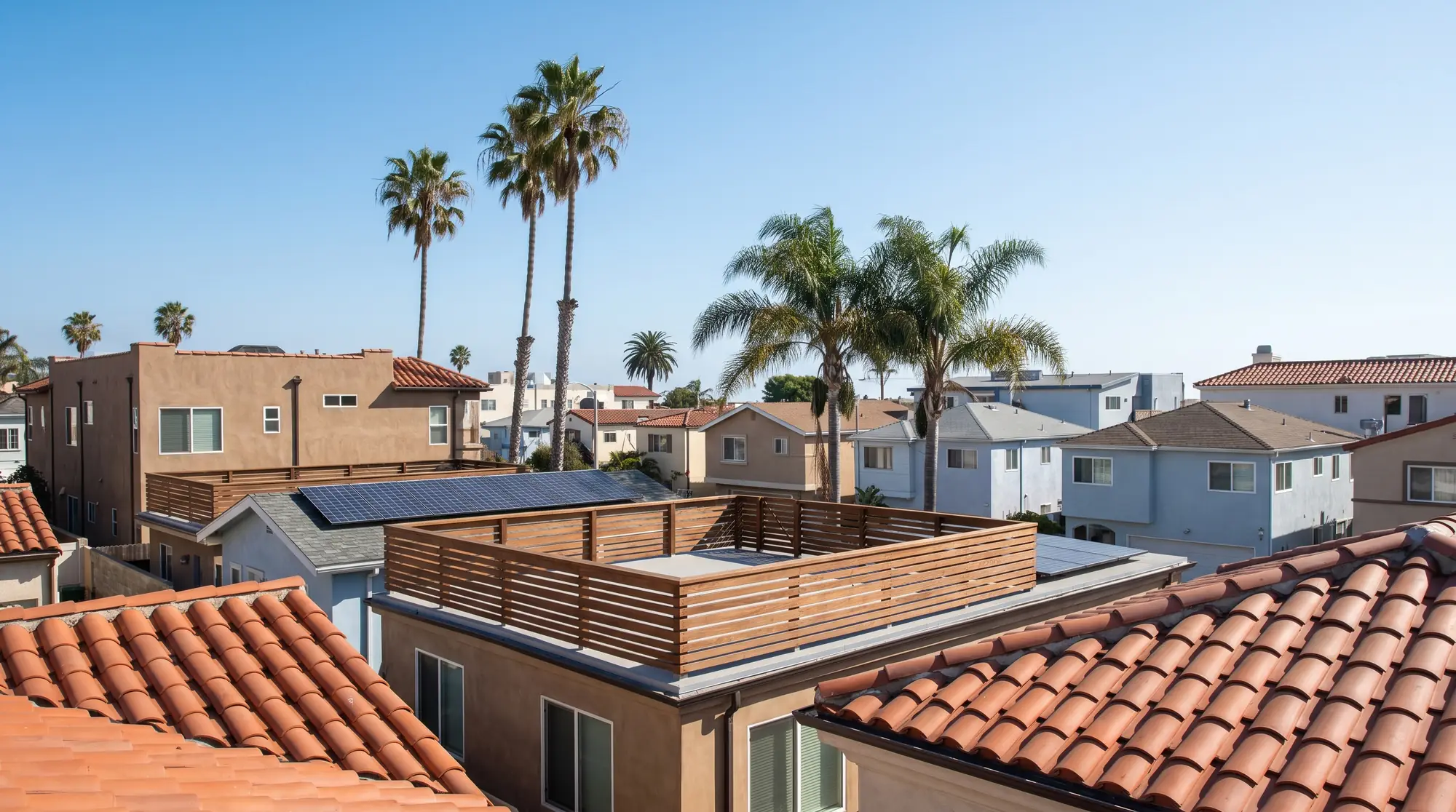
Santa Monica filled in between the 1920s and the 1950s and never got bulldozed the way other parts of the basin did. Spanish Colonial Revival and California bungalow from the twenties and thirties, wartime and postwar stucco boxes, then the 1950s and 1960s apartment stock: courtyard buildings, dingbats over tuck-under parking, and a great many two-to-four unit buildings owned by individuals. Roof shapes here are simple and often flat. The Spanish revival houses carry low-pitched tile, sometimes with a flat section hidden behind a parapet. The apartment buildings are almost all low-slope: cap sheet, modified bitumen, or TPO on the newer re-roofs. Those roofs fail at seams, at parapet flashings, at drains and scuppers, and wherever water sits after the rain instead of leaving.
The other half of the story is salt fog. The marine layer comes in most nights for much of the year, roofs stay wet into the late morning, and salt air sits on every piece of metal on the building. Fasteners corrode. Drip edge, valley metal, pipe flashing and vent collars rust from the underside where nobody can see them. Galvanized gutters and downspouts go early. Plenty of Santa Monica roofs get replaced because the metal failed, not because the tile or the membrane did. That is why stainless or hot-dipped fasteners and coastal-grade flashing are worth the line on a quote.
Age is doing its own work on top of that. Most of this stock has been re-roofed once, a lot of it in the 1990s, so a thirty-year shingle laid in 1994 is finished. There is more on both kinds of job on the roof repair and roof replacement pages.

What roof work costs in Santa Monica
These are estimate ranges for Los Angeles County, not quotes. Nothing gets quoted until someone has been up on the roof.
- Flat or low-slope systems:roughly $12,000 to $30,000.
- Composition shingle replacement:roughly $9,000 to $25,000 for a typical single-family roof.
- Tile lift and relay:roughly $12,000 to $30,000.
- New tile throughout:roughly $25,000 to $60,000 and up.
- Solar panel removal and reinstallation:roughly $4,000 to $10,000 on top of the roof itself.
Two things push Santa Monica jobs upward. Lots are small and the streets are tight, so material handling and dumpster placement take longer. And coastal-grade metal costs more than the galvanized alternative that will rust here inside a decade. Coastal grade means stainless fasteners, proper flashing, and gutters in aluminum or copper.
If you own a small multifamily building, budget on roof area, not unit count, and settle tenant notice and working hours early.
Common questions about roofing in Santa Monica
I rent in Santa Monica and the roof is leaking. What can I do?
The roof is the owner's responsibility, not yours. Most households here rent, so this is the common case. Report the leak to your landlord or property manager in writing, keep a copy, and photograph the damage with dates on the files. Written notice is what moves an older building's roof up the owner's list, and it is the record that matters if the leak keeps going.
Get the Santa Monica roof looked at
Tell us what's going on with your roof and we'll come out to look at it. Nearby: Pacific Palisades and Malibu.
The offer
$500 off a new roof, 10% off any repair
Send your request online from this page and the offer is attached, with nothing to remember.
- We get on the roof, and into the attic if that is where the answer is
- You get photographs of whatever we find
- The price in writing, with nothing to sign on the spot
Tell us what is going on
A description is enough to start. We will come out, look at the roof properly, and give you the price in writing.