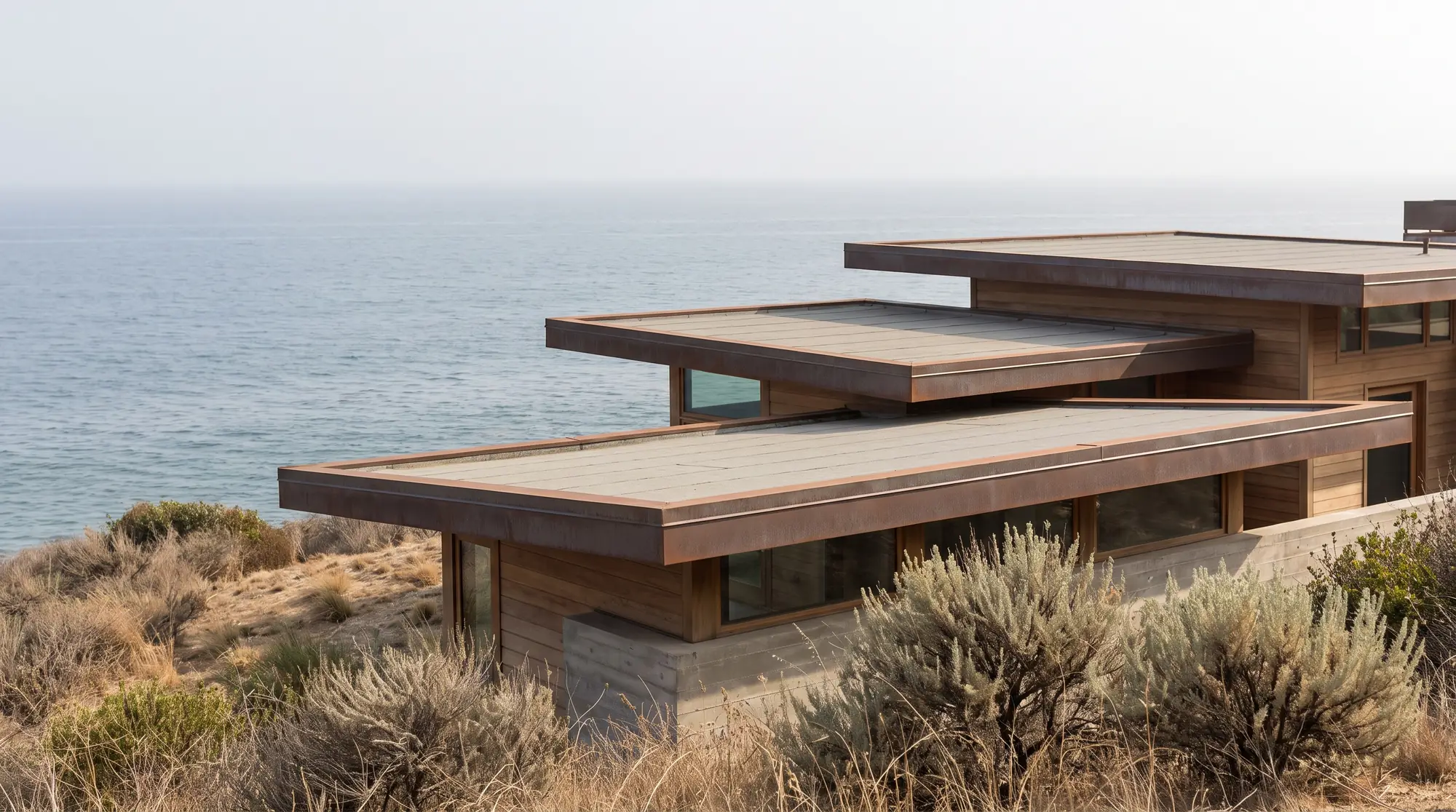
Most cities in Los Angeles County leave re-roofing to the building code and let the inspector sort out the rest. Malibu wrote it down. The City's Building Safety Division publishes a Residential Re-Roof Policy setting out what gets filed with the application, how many inspections you get, and which coverings may go over an old roof and which have to come off to bare sheathing. Two things decide the rest: the whole city sits in a Very High Fire Hazard Severity Zone, and the ocean is never far away.
Then there's the recent past. The Franklin fire started near Malibu Canyon Road in December 2024, burned more than 4,000 acres and destroyed 20 structures, with Serra Retreat and everything east of the canyon under evacuation. A month later the Palisades fire ran west along the coast through Las Flores, Big Rock and the eastern stretch of PCH; the City of Malibu puts its own losses from that fire at 720 structures inside city limits. So there are two situations here: houses being rebuilt, and standing houses that took ember fall and ash and were due a roof anyway.
How we match you with a Malibu roofer
We're not a roofing company. We hold no contractor's licence and we do no roofing work. What we do is find you someone who does, and check them before your details go anywhere.
Tell us the address, the roof type if you know it, and whether this is a standing house or a rebuild. We match you with one licensed, insured roofing contractor who works in Malibu — not a list, not five companies ringing you at dinner. You get their CSLB licence number before they arrive, so you can look it up on the state register yourself. They come out, get on the roof, and give you a written quote. Free, no obligation. If they're not the right fit, say so and we'll re-match you at no cost.
For Malibu we look past the licence for two things: somebody who has pulled permits with the City and been through its two-inspection sequence, and real coastal experience — which metals last out here, and what it takes to get a crew and a dumpster onto a lot off Latigo or Encinal Canyon.
What Malibu's housing stock means for your roof
Malibu isn't one kind of house. Point Dume and Malibu Park are largely post-war and sixties ranch stock on big lots, much of it re-roofed once in the nineties. The Colony, Broad Beach and Trancas are dense, narrow and salt-blasted, often with low-slope sections behind parapets. Serra Retreat and the canyon lots run to Spanish and Mediterranean tile. Big Rock and Las Flores are hillside and steep. County-wide the median home dates from 1965, and much of Malibu sits either side of that line.
Tile fails underneath. Clay and concrete tile lasts fifty years or more; the underlayment beneath it rarely gets past twenty-five or thirty. A Serra Retreat tile roof can look immaculate from the driveway while the felt under it has gone to powder. That's a lift and relay, not a new roof.
Salt goes after the metal first. Nails, drip edge, valley metal, pipe flashing, vent collars and gutters corrode long before the covering does. Plain galvanised fasteners rust out here in a fraction of their inland life, and a roof with perfect tiles and failed flashing still leaks. Stainless fixings, coated or copper flashing and aluminium gutters are the answer.
Fire is not an edge case. The City's own re-roof policy states plainly that Malibu is in a Very High Fire Hazard Severity Zone and that all roofing material must be rated Class A, no exceptions. CAL FIRE finished its statewide remap of those zones in March 2025, so if you last looked at a fire map years ago, look again. In Torrance or the flats of Santa Monica this rarely comes up. Here it's the starting point.
Roofing work commonly needed in Malibu
- New-construction roofs on rebuilds, usually contracted through the general contractor running the build.
- Tile lift and relay. Sound tiles come off, failed underlayment is replaced, the same tiles go back on.
- Composition shingle replacement on the post-war stock that hit its second roof in the nineties.
- Flat and low-slope work — TPO, modified bitumen and cap sheet on the bluff-top houses, failing at ponding water, split seams and parapet flashings.
- Flashing, fastener and gutter replacement driven by salt corrosion rather than by the covering giving up.
- Fire hardening: ember-resistant attic and eave vents, non-combustible gutters, a genuine Class A assembly at the next re-roof.
- Post-fire condition checks. Ash is alkaline and holds moisture in valleys and tile pans, so underlayment, vents and rafter tails want looking at.
There's more on each of those on the roof repair and roof replacement pages.
What roof work costs in Malibu
These are estimate ranges for Los Angeles County, not quotes. Nobody can price a roof without standing on it.
- Composition shingle replacement: roughly $9,000 to $25,000 for a typical single-family roof.
- Tile lift and relay: roughly $12,000 to $30,000.
- New tile throughout: roughly $25,000 to $60,000 and up.
- Flat or low-slope (TPO, modified bitumen, cap sheet): roughly $12,000 to $30,000.
- Standing seam metal: roughly $20,000 to $40,000.
- Solar removal and reinstall: roughly $4,000 to $10,000, on top of the roof itself.
Malibu sits at the top end of all of those. Houses are larger with more complicated rooflines, and coastal-grade metal costs more than galvanised. The City's policy also takes the cheapest option off the table on most jobs: lightweight tile and metal panels both require the old roof system to come off completely, down to exposed sheathing. A real tear-off means disposal, more labour, and a fair chance of finding decking to replace at $70 to $100 a sheet installed.
Then there's access. Delivery, crew time and dumpster placement on a lot off Latigo, Corral or Decker cost more than the square footage suggests, and on the beach side there's often nowhere to put a dumpster at all without arranging it first. Ask for access and disposal to be line-itemed. Fuller breakdown on the roofing costs page.
Permits and code in Malibu
Malibu issues its own permits
Get this straight first, because a Malibu address makes people assume the City of Los Angeles. Malibu is its own city with its own Building Safety Division, inside the Community Development Department, and that's who issues your permit and sends the inspector. LADBS has no authority here. Malibu has adopted the 2026 County of Los Angeles Building Codes with amendments, so a roofer fluent in LADBS paperwork isn't automatically fluent in this.
What the Residential Re-Roof Policy requires
- A permit before any work starts. Every roofing installation, new roof or re-roof, needs one. There's no small-enough version.
- The listing gets filed, not just claimed. The roofing product's listing or test report — from I.C.C., U.L., E.T.L. or another approved testing lab — goes in with the application, and the manufacturer's listing and installation instructions stay on the job site the whole time the work is going on. Elsewhere you argue afterwards about whether a Class A assembly was really built. Here you file it up front.
- A minimum of two inspections. No new covering goes on until the City has inspected and approved in writing. That first inspection looks at water accumulation, drainage, the condition of the flashing and the soundness of the substrate underneath. A final closes it out.
- Limits on going over the old roof. One overlay of asphalt shingle over existing asphalt is allowed. Tile over existing tile is allowed only where plans and calculations show the existing or modified roof framing can carry the extra load, and those plans and calculations have to be stamped and wet-signed by a California Registered Engineer or a Licensed Architect and go through plan review before the permit is issued. Normal weight tile, over six pounds per square foot, carries that same stamped and wet-signed requirement on any application. Lightweight tile at six pounds or less may not need plan check, but the old roof has to come off completely to exposed sheathing — and metal panels, standing seam included, come off the same way. Wood shakes and shingles are prohibited outright within city limits.
It also requires roofing materials to meet Cool Roof Rating Council requirements under the 2026 County of Los Angeles Green Building Standards Code, which narrows the product and color choice.
The coastal permit question
Malibu is one of the few California cities with its own certified Local Coastal Program, so some work needs a Coastal Development Permit on top of the building permit. A like-for-like re-roof usually won't. Where owners get caught is a change of material, profile, height or bulk on a beachfront or bluff parcel, or a rebuild, where a replacement structure has to keep within about ten percent of the original floor area, height and bulk to stay exempt. Ask the Planning Department, not your roofer.
Your matched contractor's licence
Every contractor we match you with holds a current CSLB licence — a C-39 roofing classification, or a B general building licence where the roof sits inside a larger job — and carries liability insurance and workers' compensation cover. We check status, classification, bond and insurance before your details go over, and you get the number up front to verify yourself.
To be clear about who is who: your contract is with the roofing contractor. Any workmanship guarantee, and any manufacturer's material warranty, comes from them — not from us.
Common questions about roofing in Malibu
Can I just have the new roof laid over the old one?
Sometimes. One overlay of asphalt shingle over an existing asphalt roof is allowed. Tile over existing tile needs plans and calculations showing the framing can carry the extra load, stamped and wet-signed by a California Registered Engineer or a Licensed Architect, and put through plan review before the permit issues. Lightweight tile and metal panels require the old system off to bare sheathing. If a quote is cheap because nothing is being torn off, check it against the policy.
Can I put wood shakes back on a Malibu house?
No. The City's re-roof policy prohibits installing wood shakes and shingles within city limits. If you have them now, the replacement will be a different material.
Do I need a Coastal Development Permit to re-roof?
Usually not for a like-for-like replacement. You may well need one if you're changing material, profile, height or bulk, and the question gets sharper on a beachfront or bluff lot. Ask Planning early — finding out after the contract is signed is the expensive version.
Why does an inspector need to see the roof before the new covering goes on?
Because that's where the real condition shows: standing water, drainage that doesn't work, tired flashing, and whether the sheathing is sound. It's the same moment your roofer finds rotten decking. Expect a contract that says what happens if the deck turns out bad.
Should I re-roof before adding solar?
If the roof is fifteen years old or more, yes. Panels have to come off for a re-roof, which runs roughly $4,000 to $10,000 on top of the roof work. On a rebuild the roof goes on first and the array is designed with it.
Rain season runs October to March, and the best time to get roof work done here is late spring through early autumn. When you're ready, tell us what's going on and we'll match you with one licensed Malibu roofer, licence number up front. Nearby: Pacific Palisades and Santa Monica.