Encino
Roofing Contractors in Encino
Encino has no building department of its own, so the permit for a reroof comes from LADBS, and the Valley counter is on Van Nuys Boulevard. On the state fire map redrawn in 2025 the hazard line crosses the neighborhood on a diagonal: at the Tarzana end it sits the better part of a mile up the hill, it reaches Ventura Boulevard at Louise Avenue, and by Balboa the boulevard itself is mapped Very High on both sides.
Free, and there is no obligation to go ahead.
- Free roof inspection
Someone comes out, gets on the roof, and tells you what they find.
- The price in writing
A written quote before anyone starts, with nothing to sign on the day.
- Licensed roofers
The roofer who turns up holds a current California license.
- Across Los Angeles County
From the Valley and the foothills to the Westside and the South Bay.
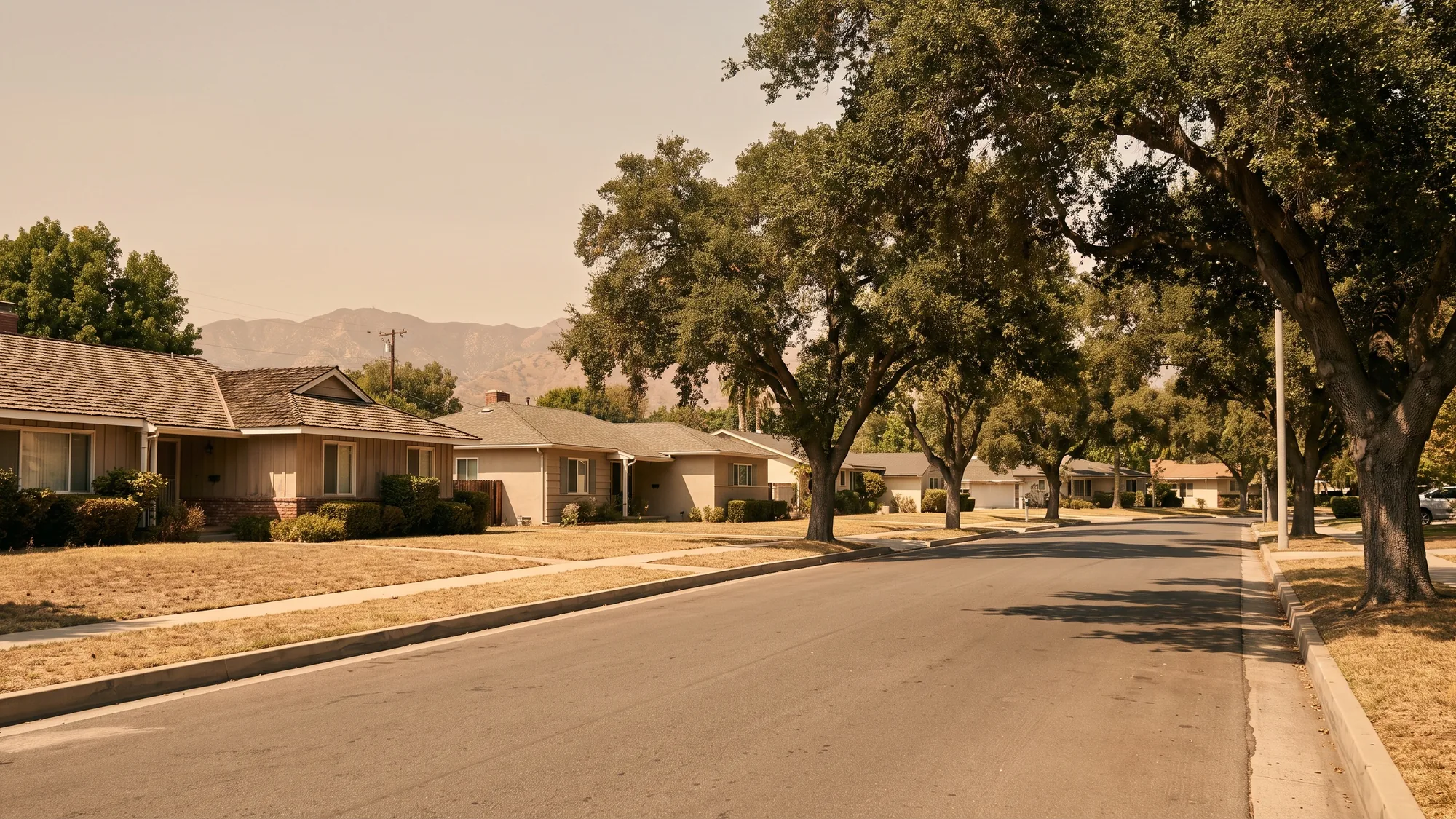
Encino is a City of Los Angeles neighborhood with no building department of its own, so the permit for a reroof comes from LADBS. The place was named for its oaks in 1769 and the oaks are still standing over the roofs. And the state fire map redrawn in 2025 cuts across the neighborhood on a diagonal, so two houses on the same boulevard can sit in different zones. All of that lands on a roofing quote.
- Housing stockPostwar post-and-beam tracts north of Ventura, tile on the larger houses climbing south
- Permit authorityLADBS, at the Van Nuys Development Services Center
- Typical hereTile relay $12,000 to $30,000
- Worth knowingThe hazard line runs on a diagonal here, not along Ventura Boulevard
What Encino's housing means for your roof
North of the boulevard, Encino Village is the clearest case. A little over 400 houses went up in two phases between 1955 and 1957 on the bulldozed backlot of RKO's Encino Ranch, every one of them designed by Martin Stern Jr. for the Marwill Corporation in four styles and five floor plans, so low-gabled moderns sit next door to Colonials with weathervanes on them. Most are a hybrid post and beam, and in many of them the beams show in the ceiling. Two things follow from that. A low gable sits near the bottom of what composition shingle is rated to handle, so water gets in at the eave, the valley and the wall flashing years before the field of shingle is worn out. And where the ceiling is open beam there is no attic above it, so nothing catches a leak and there is nowhere to crawl and trace it. The first sign is a stain on finished wood.
South of Ventura Boulevard the work changes. Encino Hills climbs from the boulevard up to Mulholland Drive on switchback streets with short driveways, so staging a tear-off costs hours that the same house on a flat Village lot would not. The covering is heavier as well, and on a tile roof the tile is almost never the thing that failed. Underlayment has a service life and it ends decades before the tile does, which is why a roof can look sound from the street and still be wetting the ceiling below. The answer there is usually a lift and relay: sound tile comes off, the underlayment is replaced, the same tile goes back. At the top of the hill one more rule shows up. The Mulholland Scenic Parkway Specific Plan draws an inner corridor of the right of way plus 500 feet outward, and inside it a roof visible from Mulholland Drive has to be surfaced in non-glare material and carry nothing on it except solar. Repair and remodeling of a single-family house can skip that plan's design review, but only where the color and materials line up with what the plan asks for, so up there the roofing material gets settled before the order goes in.
Every address in Encino permits through LADBS, and the Valley office is the Development Services Center at 6262 Van Nuys Boulevard. The fire zone is the part that catches people. Encino sits entirely inside a local responsibility area, so the mapped zone is the whole answer, and that answer changes as you move along Ventura Boulevard. At Lindley and at White Oak the boulevard reads NonWildland, and at the Lindley end the first High reading is more than three quarters of a mile up the hill. At Louise Avenue the zone reaches the boulevard and reads High. At Amestoy the boulevard reads Very High and the north side of it reads High. From Genesta east through Balboa both sides read Very High, and Los Encinos State Historic Park with the 1849 adobe on it reads Very High as well. There is a short break back to High and Moderate around Hayvenhurst, then Very High again past Woodley. North of Balboa the map steps down through a band of High and a band of Moderate and stops classifying about a third of a mile up. More on both kinds of job is on the roof repair and roof replacement pages.

What roof work costs in Encino
Estimate ranges for Los Angeles County, not quotes.
- Small repair(slipped tiles, resealing a vent, clearing a drain): roughly $400 to $900.
- Single-source leak(chimney or skylight flashing, a localized shingle repair, a flat-roof seam): roughly $800 to $2,500.
- Composition shingle replacement:roughly $9,000 to $25,000.
- Tile lift and relay:roughly $12,000 to $30,000.
- New tile throughout:roughly $25,000 to $60,000.
- Flat or low-slope (TPO, modified bitumen, cap sheet):roughly $12,000 to $30,000.
- Solar panel removal and reinstall:roughly $4,000 to $10,000, on top of the roof itself.
Which end of those ranges an Encino job lands on depends mostly on how far up the hill it sits and what the map says about the parcel. In the flats the lots are wide, the roof shapes are simple and the dumpster goes on the driveway, so a composition re-roof stays near the middle. Up the slope the access eats hours and tile is slow to handle, and a parcel mapped High or Very High carries the fire assembly underneath the covering. One rule applies wherever the house sits: the Los Angeles Green Building Code requires a rated cool-roof product once you replace more than half the roof area, which narrows the material list on a full re-roof and leaves a repair alone. The roofing costs page breaks that down.
Common questions about roofing in Encino
Which fire zone is my Encino house in?
Check the address, because it changes within a few blocks here. CAL FIRE issued new local responsibility area maps for Southern California on March 24, 2025, and on the current map most of the Encino hillside up to Mulholland Drive is Very High, but not all of it. At the Tarzana end the Very High zone does not begin until roughly a mile south of Ventura Boulevard, with NonWildland, Moderate and High below it. Along the boulevard the map reads NonWildland at White Oak, High at Louise, and Very High from Amestoy through Balboa, with the zone carrying over onto the north side from Genesta east. It decides the job. The California Wildland-Urban Interface Code took effect January 1, 2026, replacing Chapter 7A of the building code, and it applies to any parcel mapped High or Very High. LADBS says the same in its own plan check checklist, which points at the local and the state maps together. Moderate on its own does not bring it in.
What actually changes on a re-roof in the High or Very High zone?
The assembly has to carry a Class A fire classification, and wood shake and wood shingle are out, including the fire-retardant-treated kind. If half or more of the covering is replaced inside twelve months, the whole roof has to meet the new-construction standard and not only the new part. Under barrel tile on a wood deck, where the profile leaves an air space, the deck takes a 72 pound cap sheet, bird stops go in at the eaves, and the hip and ridge caps are mudded in so embers cannot get underneath. Valleys need 26 gauge or heavier corrosion-resistant metal over a 36 inch wide cap sheet running the full length. Gutters have to be noncombustible with an approved means of keeping leaves out. Open eaves have to be protected on the underside, which is the expensive surprise on a mid-century house built to show its overhang. Those sit in CWUIC sections 504.2 through 504.4, and LADBS publishes the full list as a supplemental checklist that your plan check engineer works through line by line.
There is a big oak over my roof. Can I cut it back for the fire clearance?
Not on your own say-so. Fray Juan Crespi named this valley for its oaks in 1769, and the coast live oaks are still dropping leaves into the gutters of houses built underneath them. In the Very High zone, LAFD brush clearance asks for roof surfaces kept clear of accumulated leaves and twigs, five feet of vertical clearance between the roof and overhanging foliage, and ten feet between foliage and a chimney outlet. The California live oak is also a protected tree under Los Angeles Municipal Code sections 46.00 through 46.06, at four inches of cumulative trunk diameter measured four and a half feet up, and relocating or removing one needs a permit from the Board of Public Works. Removal there covers any act that causes the tree to die, root damage included, and the fire department's own page says fire clearance has to comply with the tree ordinance. So the sequence is clearance and gutter work first, an arborist and a permit before anything comes off the oak.
Tell us the address and what is happening up there: tell us what's going on. We also cover roofing contractors in Sherman Oaks and roofing contractors in Woodland Hills.
The offer
$500 off a new roof, 10% off any repair
Start online and it is attached to your request, with nothing to remember.
- We get on the roof, and into the attic if that is where the answer is
- You get photographs of whatever we find
- The price in writing, with nothing to sign on the day
Tell us what is going on
A description is enough to start. We will come out, look at the roof properly, and give you the price in writing.