Torrance
Roofers in Torrance
About 19,000 Torrance homes were built in the 1950s, and most are on a roof laid in the 1990s. Tell us what's going on and we'll come out and look at yours. Free inspection and written quote, no obligation.
- Free roof inspection
We come out, get on the roof, and tell you what we find.
- The price in writing
A written quote before anyone starts, with nothing to sign on the spot.
- Licensed roofers
Our roofer who comes out holds a current California license.
- Across Los Angeles County
From the Valley and the foothills to the Westside and the South Bay.
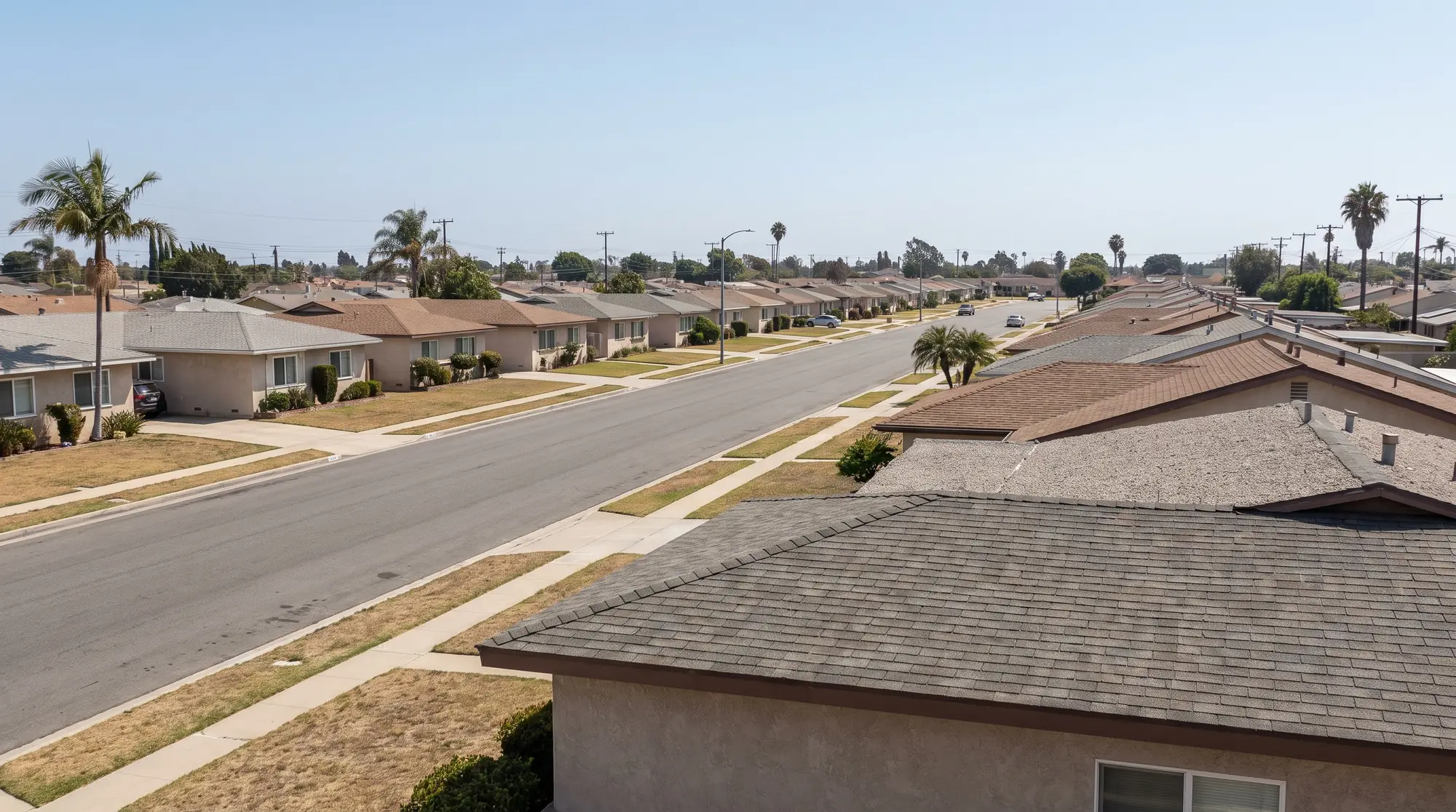
Most roofs in Torrance are worn out by age. About 19,300 housing units here were completed in the 1950s, a third of everything in the city, on the Census Bureau's 2024 American Community Survey five-year estimates. The typical Torrance house is now on its second or third roof, and a lot of those roofs went down in the 1990s. A thirty-year architectural shingle laid in 1994 is thirty-two years old and used up, though it has not failed dramatically.
- Housing stockPostwar tract, shallow pitch, 1950s decking under a 1990s roof
- Typical hereComp re-roof $9,000 to $25,000
- Watch forLow slope gives water longer to find a fault
What the 1950s build-out means for your roof
The build-out covered Southwood, West Torrance, the tracts spreading out from Old Torrance, and the earlier hillside streets of the Hollywood Riviera. It produced tens of thousands of single-story ranch houses with attached garages, simple gable or hip roofs, long uninterrupted runs and shallow pitch. Most of these houses are owner-occupied, which is unusual for the county and means the roof is the owner's problem, not a landlord's.
On those 1990s re-roofs the end shows from the ground: granules collecting at the bottom of the downspouts, a patchy matte surface, edges curling at the corners, shingles that crack underfoot, nail pops, a ridge line that reads slightly wavy.
Pitch is the real Torrance problem. A lot of these ranch roofs run around 3:12 or 4:12. Below 4:12 a shingle roof needs a specific underlayment build-up, usually a doubled or fully adhered layer, to work. Plenty of the 1990s re-roofs on these streets were installed as if the pitch were steeper. That is why a Torrance roof leaks in the valleys and at the eaves while the field looks fine, and it is the first thing we check here. The seam where the attached garage meets the house is the second.
There is more detail on the roof repair and roof replacement pages.
Sitting a couple of miles from the water, Torrance also gets mild marine air. Nothing like the exposure in Pacific Palisades or Santa Monica, but enough to shorten the life of cheap galvanized fasteners, flashing and gutters.
Ask whether your quote is a tear-off or an overlay, and why. Pulling the permit is our job, not yours.

What roof work costs in Torrance
Estimate ranges, not quotes. Nobody can price your roof without getting on it first.
- Composition shingle replacement:roughly $9,000 to $25,000 for a typical single-family roof.
- Flat or low-slope sections:roughly $12,000 to $30,000 for a whole low-slope roof; a garage or patio section alone is a fraction of that.
- Tile lift and relay, where a house has tile: roughly $12,000 to $30,000.
- Solar panel removal and reinstallation:roughly $4,000 to $10,000 on top of the roof itself.
Torrance tends to sit toward the lower half of the shingle range. Single story, simple roof shapes, easy driveway access for a dumpster, few dormers or turrets to detail around. What pushes a Torrance quote up is the low-slope work bolted onto the side of the house: the garage extension, the patio cover, the occasional flat-roofed mid-century.
Common questions about roofing in Torrance
Why does my Torrance roof leak at the eaves when the shingles look fine?
Almost always the pitch. Many 1950s Torrance ranch roofs are 3:12 or 4:12, and at that angle water moves slowly enough to work backward under the shingle. The underlayment, not the shingle, is what keeps it out, and a low-pitch roof needs a doubled or fully adhered underlayment layer to do that. If your last re-roof used a standard single layer, the field of the roof can look almost new while the valleys and eaves let water in. It is fixed properly at replacement, when the deck is open.
Why are roof quotes in Torrance often lower than elsewhere in LA?
Shape. A Torrance ranch is one story with a simple gable or hip, a long clean run, and a driveway a dumpster can sit in. Little to detail around, little to stage. That is why composition shingle replacement here often lands in the lower half of the $9,000 to $25,000 range. The costs that move it are a rotten deck found at tear-off, a low-slope garage or patio section, and solar panels that have to come off and go back on at roughly $4,000 to $10,000.
The offer
$500 off a new roof, 10% off any repair
Send your request online from this page and the offer is attached, with nothing to remember.
- We get on the roof, and into the attic if that is where the answer is
- You get photographs of whatever we find
- The price in writing, with nothing to sign on the spot
Tell us what is going on
A description is enough to start. We will come out, look at the roof properly, and give you the price in writing.