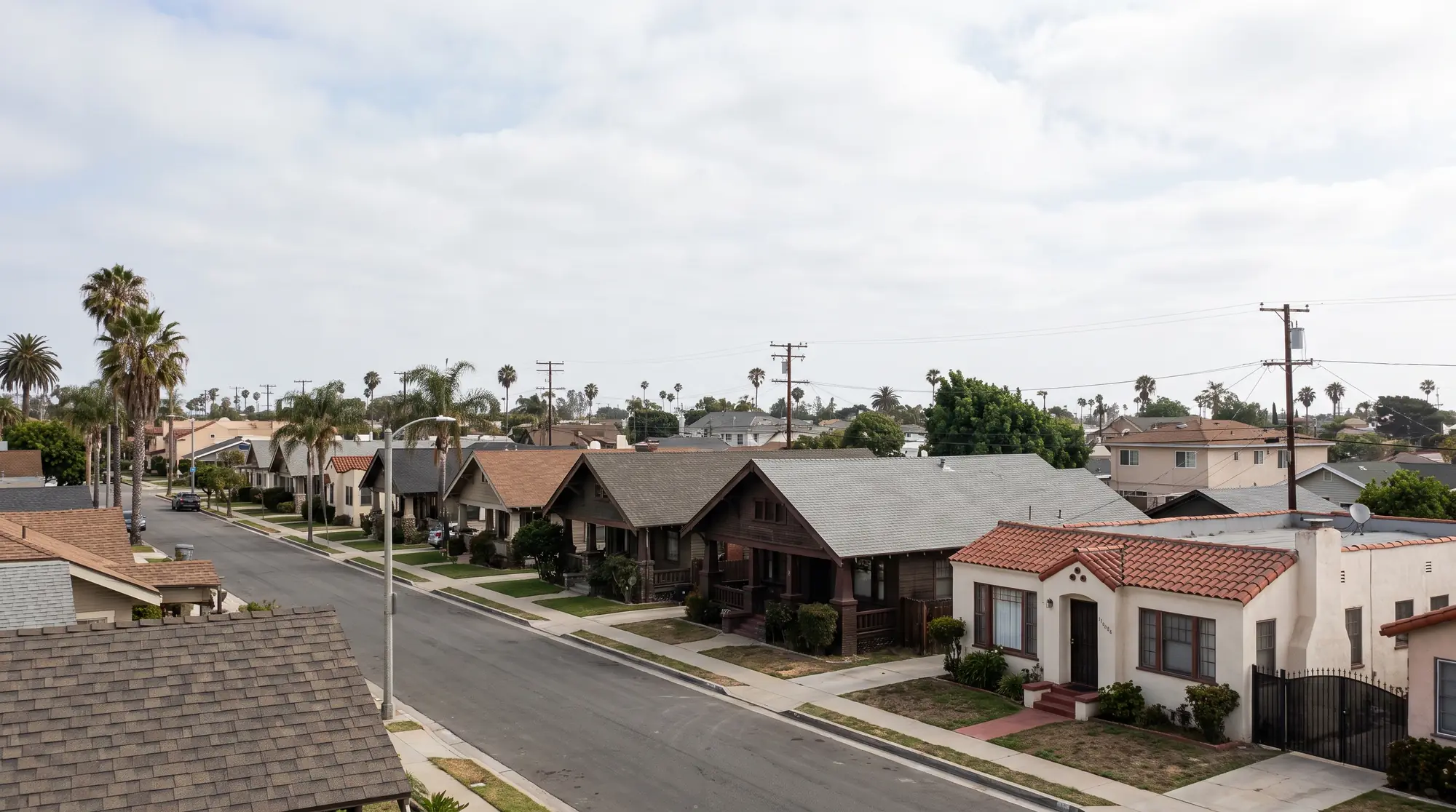
Long Beach has eighteen designated historic districts as of August 2026, and which side of a district line your house sits on changes a roofing job more than almost anything else about the building. The city requires historic review before you re-roof inside one, and that review reaches the size, color and patterning of the roofing material — not just whether it's tile or shingle. So the most useful thing anyone can tell you here comes before the quote rather than after it: find out which district you're in, or that you're in none of them.
The eighteen are Bluff Park (1982), Minerva Place and Wrigley Area (1989), Carroll Park and Sunrise Boulevard (1990), Hellman Street Craftsman and Lowena Drive (1992), Brenner Place and Linden Avenue (1994), Wilton Street (1995), Rose Park (1997), Drake Park/Wilmore City (1998), California Heights (1990, expanded 2000), Rose Park South (2001), Belmont Heights (2002), Eliot Lane (2003), Bluff Heights (2004) and the Grant Neighborhood (2019). California Heights is the largest, roughly 1,500 houses between Wardlow and Bixby. A lot of those roofs are due.
How we match you with a Long Beach roofer
We're not a roofing company. We hold no contractor's licence and do no roofing work. We find you someone who does, and check them before your details go anywhere.
Tell us the address, the roof type if you know it, and whether it's a house you live in or a building with tenants in it. We match you with one licensed, insured roofing contractor who already works in Long Beach — not a list to chase, not five firms calling you at dinner. You get their CSLB licence number before they turn up, so you can look it up on the state register yourself. They come out, get on the roof and into the attic, and give you a written quote. Free, no obligation. If they're not the right fit, tell us and we'll re-match you at no cost.
For Long Beach we filter for two things past the licence: someone who has been through the city's historic review before, and genuine low-slope experience, because a lot of this city's roof area is flat.
Said plainly: most households here rent, and if you rent, the roof is your landlord's problem, not yours — put the leak in writing and photograph it with dates. This page is for the people who pay for roofs in Long Beach: owner-occupiers, and small landlords holding a duplex, a fourplex or a courtyard building.
What Long Beach's housing stock means for your roof
Long Beach is three roofing towns inside one city limit, and a contractor who is good at one isn't automatically good at the others.
The pre-war neighbourhoods. Bluff Park, Belmont Heights, Rose Park, Wrigley and California Heights went up in the 1920s and 1930s — Spanish Colonial Revival, Craftsman bungalows, a run of Tudor Revival. Clay and concrete tile, and steeper composition over complicated shapes: dormers, porch roofs tying into a main slope, deep eaves, plenty of valleys. Tile roofs almost never fail at the tile. Tile lasts fifty years and more; the underlayment beneath it rarely gets past twenty-five or thirty. That's why a tile roof can be soaking the ceiling below and look perfect from the sidewalk.
The postwar tracts. East Long Beach, Los Altos and Lakewood Village are a different city: single-storey ranch houses, simple gable and hip roofs, shallow pitch. Same clock as Torrance — built in the fifties, re-roofed in the nineties with a thirty-year composition shingle, and a thirty-year shingle laid in 1994 is finished. Not damaged, finished. Granules in the gutters, corners curling, shingles that crack instead of flexing.
The small multifamily stock. Duplexes, fourplexes, courtyard buildings and dingbats over tuck-under parking, thick through Alamitos Beach, Rose Park and the streets off Broadway and Fourth. Almost all low-slope: cap sheet, modified bitumen, or TPO on newer re-roofs. These fail at seams, parapet flashings, drains and scuppers — anywhere water sits after the rain.
Then there's the salt. The Peninsula, Naples, Belmont Shore, the Alamitos Bay side and the face of the Bluff take marine air directly, and down there the metal usually gives out before the covering does. Drip edge, valley metal, pipe flashing and vent collars rust from the underside where nobody sees them, and galvanised gutters go early. Stainless or hot-dipped fasteners, coastal-grade flashing and aluminium or copper gutters are worth paying for, and worth seeing on the quote.
Underneath all three is age. LA County's median home was built in 1965 and much of Long Beach is older. There's no hail here and no storm season, so almost nothing on a Long Beach roof is damaged. It's just finished.
Roofing work commonly needed in Long Beach
- Tile lift and relay on the pre-war stock. Sound tiles come off, dead underlayment is stripped, new goes down, the same tiles go back — which keeps the roof looking like itself, and matters enormously inside a district.
- Composition shingle replacement across the postwar tracts: straightforward age-out on 1990s roofs.
- Low-slope replacement and repair on the apartment stock — TPO, modified bitumen and cap sheet. Ponding, split seams and failed scupper flashings are the usual complaints.
- Coastal flashing, fastener and gutter replacement driven by corrosion rather than by the covering failing.
- Rain-season leak repair, October to March: chimney and skylight flashing, valley metal, perished pipe boots.
- Re-roofing before solar, or removing and reinstalling panels to get at the deck.
There's more on the roof repair and roof replacement pages, and if you own an apartment building rather than a house, on commercial roofing.
What roof work costs in Long Beach
These are estimate ranges for Los Angeles County, not quotes. Nobody can price a roof without standing on it.
- Small repair — slipped tiles, resealing a vent, clearing a drain: roughly $400 to $900. A single-source leak such as chimney flashing or a flat-roof seam: roughly $800 to $2,500.
- Composition shingle replacement: roughly $9,000 to $25,000.
- Tile lift and relay: roughly $12,000 to $30,000.
- New tile throughout: roughly $25,000 to $60,000 and up.
- Flat or low-slope (TPO, modified bitumen, cap sheet): roughly $12,000 to $30,000.
- Solar panel removal and reinstall: roughly $4,000 to $10,000, on top of the roof itself.
Where a job lands in those ranges is mostly geography. The postwar tracts in the east are efficient roofs to work on — single storey, simple shapes, alley access for a dumpster — and they sit in the lower half of the shingle range. The pre-war districts push the other way: heavier material, busier rooflines, and matching a historic tile or profile costs money before anyone climbs a ladder. Naples and the Peninsula add tight streets and coastal-grade metal. If the deck comes up rotten, decking runs $70 to $100 a sheet installed, and no quote can say in advance how many sheets there are.
Permits and code in Long Beach
Long Beach permits its own work. Not LADBS, and not LA County either. Re-roofs are permitted and inspected by the city's Building and Safety Bureau, part of Development Services, out of the permit centre at 411 W. Ocean Boulevard. Pulling the permit is your contractor's job, under their own licence. If someone offers to skip it to save you money, end the conversation there.
One useful local detail: Long Beach lets registered licensed contractors pull simple re-roof permits online, as an express permit with no plan review, for one- and two-family dwellings and their accessory structures. Ask whether your job qualifies — the answer tells you how fast work can start, and if it's no, the reason is usually the next section.
If your address is in a historic district
Any exterior change to a designated landmark, or to a property inside one of the eighteen districts, needs a Certificate of Appropriateness. The municipal code sets the test: the change must not adversely affect the historical, architectural or aesthetic features of the property or the district, and it has to suit the building's period and the contributing structures around it. Staff handle minor applications; the Cultural Heritage Commission takes the bigger ones.
A roof is squarely in scope. The city's guidelines list roof shape, dormers, cupolas, eaves and chimneys, and then the size, color and patterning of the roofing material. Like-for-like — same material, same profile, sympathetic color — is the shortest path through. Swapping clay barrel tile for whatever's cheapest on the truck is not. Re-roofing has its own short COA form, separate from the minor and major applications, and as of August 2026 the city's historic preservation page states there is no fee for historic review on a re-roofing application. Don't treat that as banked: Long Beach adopts a new fee resolution each fiscal year, and the fiscal year turns over on 1 October. Ask the Planning Bureau on 562.570.6194 what the current fee is before you budget. What the review certainly costs is time, and it comes before the building permit, not alongside it.
If you hold a Mills Act contract — Long Beach runs one of these programmes, a ten-year agreement rolling forward each year that trades property tax relief for keeping a historic building's character — the same review applies, and the stakes are higher. An unsympathetic roof can put the contract itself at risk. That's an expensive way to save a few thousand on materials.
Layers, cool roofs and fire zones
California limits how many roof coverings can be stacked, so on a house re-roofed twice already a tear-off is often required rather than optional. Ask whether you're quoted a tear-off or an overlay. The state energy code touches re-roofs too, with reflectance rules on low-slope sections, which bites hardest on the apartment stock. And CAL FIRE released the final Southern California phase of its updated fire hazard severity zone maps on 24 March 2025 — worth checking for any address in the county, though Long Beach is flat and dense and the Chapter 7A assembly rules that dominate roofing in the canyons generally don't reach here.
Your matched contractor's licence
Every contractor we match you with holds a current CSLB licence — a C-39 roofing classification, or a B general building licence where the roof sits inside a larger job — and carries liability insurance and workers' compensation cover. We check the status is active, the classification covers roofing, workers' comp is on file or a valid exemption is, and the bond is current. You get the number up front to verify on the state register yourself.
To be clear about who is who: your contract is with the roofing contractor. The work, any workmanship guarantee and any manufacturer's material warranty come from them, not from us.
Common questions about roofing in Long Beach
How do I find out whether my house is in a historic district?
The city publishes a historic districts map, and the Planning Bureau's historic preservation staff will confirm a specific address — 562.570.6194 or historicpreservation@longbeach.gov. Do it before you accept a quote — a district changes the material you can use, adds a review step ahead of the permit, and can change the price.
I'm in a district. Do I have to put the original material back?
Usually yes, and it's often cheaper than it sounds — a lift and relay reuses your existing tiles, which by definition match. Where people get stuck is choosing a color or profile first and asking about review second. Settle the material with preservation staff, then get it priced.
My tiles look perfect. Why would I need anything done?
Because tile outlasts the felt beneath it by decades. Tile is good for fifty years or more; underlayment rarely passes twenty-five or thirty. A tile roof leaking into a bedroom while looking immaculate from the street is the ordinary case in the older districts.
I own a fourplex. Is that a different job from a house?
The roof is often simpler — one low-slope plane instead of a cut-up pitched roof. The complications sit underneath it: access over occupied units, notice to tenants, working hours, and somewhere to put the dumpster. Say up front that it's tenanted so we match you accordingly.
When's the best time to do this?
Late spring through early autumn. Roofers are least stretched, dry weather makes for clean work, and you're ahead of the October to March rain rather than chasing it. Inside a district, start earlier, because the review runs before the permit.
Tell us what's going on with your roof and we'll match you with one licensed Long Beach roofer, licence number up front. Nearby: Torrance.