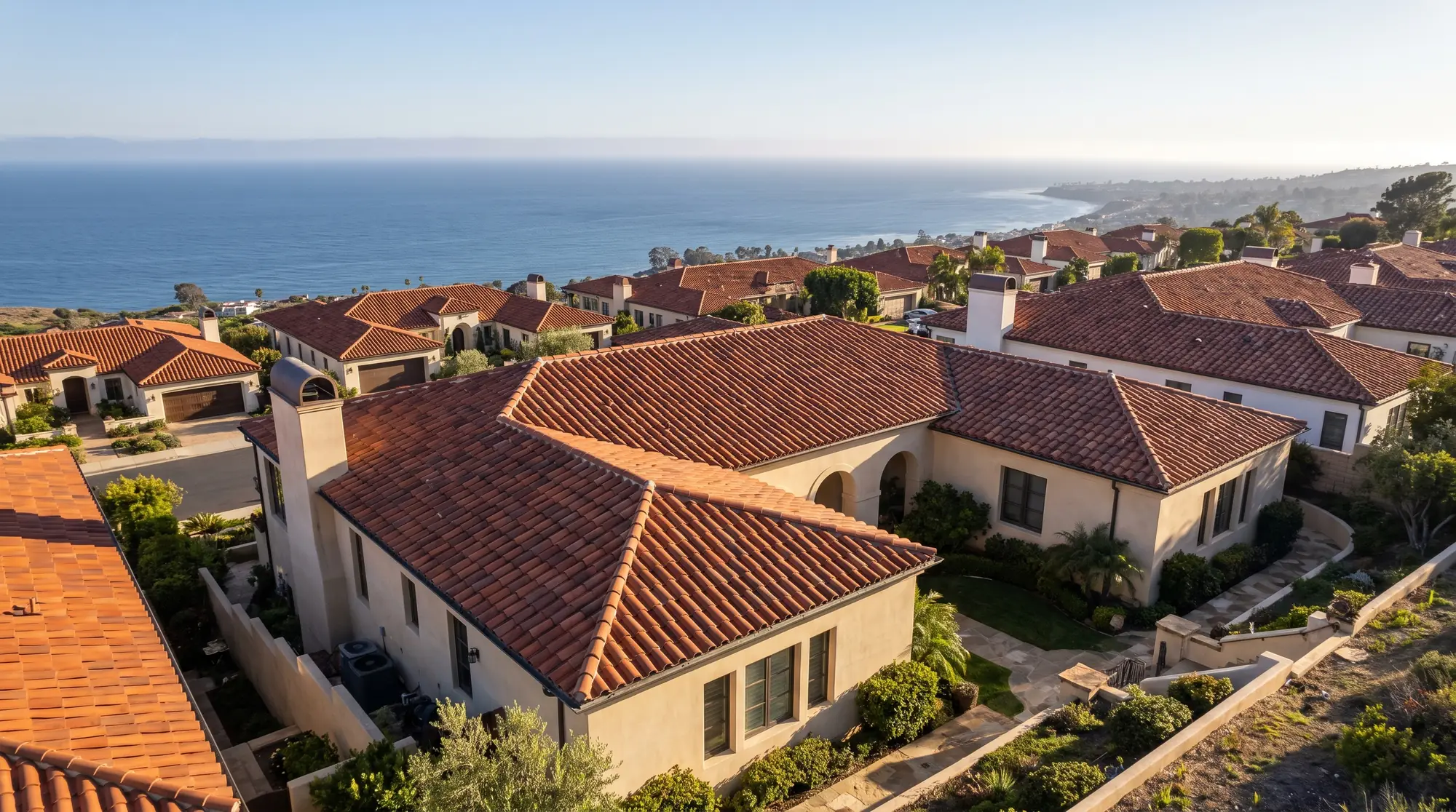
In most of Los Angeles County your roof is a building component. In Palos Verdes Estates it's a regulated one. Protective deed restrictions recorded in 1923 created an art jury that reviewed every set of plans on this land, controlling style, material, color and even the pitch of the roof — and those restrictions still run with the property. A re-roof here needs two approvals, not one: the Palos Verdes Homes Association Art Jury first, the city building permit second. A roofer who has never worked here will price and schedule as though there were only the permit, and that's where PVE jobs go wrong.
How we match you with a Palos Verdes Estates roofer
We're not a roofing company. We hold no contractor's licence and do no roofing work. We find you someone who does, and we check them before your details go anywhere.
Tell us the address, the roof type if you know it, and where you are in the process — a leak, a tile roof you suspect is due, or an Art Jury application you haven't started. We match you with one licensed, insured roofing contractor working in Palos Verdes Estates. Not a list, not five companies calling you at dinner. You get their CSLB licence number before they arrive, so you can look it up on the state register yourself. They come out, get on the roof and into the attic, and give you a written quote. Free, no obligation. If they're not the right fit, say so and we'll re-match you at no cost.
For this city we filter for two things beyond the licence: real tile experience, because most of what needs doing here is tile work, and someone who has been through an Art Jury submittal and knows what the Association wants to see.
The Art Jury approves your roof before the city does
The Palos Verdes Homes Association sits at 320 Palos Verdes Drive West, and its Art Jury has reviewed building and property changes here since 1923. Its remit isn't limited to new builds and remodels. The Association's own guidance names re-roofing directly, alongside repainting and replacing windows and doors, and says plainly that no structure can be built or altered in any way without Art Jury approval. Roofing has its own application form, and its first submittal criterion is blunt: no work of any kind shall commence prior to Art Jury approval. What's being judged is aesthetic appearance, whether the material suits the architectural style of the house, and the impact on neighbourhood character, with roof types classified by district in compliance with the deed restrictions. The districts are the architectural types set by the restrictions, each with its own permitted roof materials and pitch limits, so what's allowed depends on which one your lot sits in. Ask the Association for your property's architectural type and allowed roof type before anyone picks a material — the application has a line for it.
What the Art Jury will not approve. The roofing application is explicit that no approval is given for asphalt shingle roofing, for materials imitating slate or clay tile, for alternative materials in a district where burned clay tile or slate is mandatory, or for rake end tiles. The Association's Architect's Kit lists asphalt or composition shingle roofing as not allowed at all, with one exception — underneath solar panels — and notes wood shingles and shakes are out because of the fire zones. If a contractor quotes you comp shingle in this city, they have never worked here.
What the submittal involves. The form itself asks for the proposed roof material, color, manufacturer and product name, and what's on the roof now. Beyond that the Association may ask for some or all of: photographs of the existing roof as it reads from the street, a physical sample of the proposed material, the manufacturer's literature and installation instructions, and details of how the eave, rake, ridge, gutter or skylight will be finished. Assume a sample rather than a color name over the phone. Applications go in ahead of a posted deadline before each meeting. Rotating Art Jury members review smaller projects weekly on Tuesdays, with items due by noon the Monday before; the full Art Jury reviews larger projects on Mondays — generally the first and third of the month — with items due by 3pm the preceding Thursday. The Association tells applicants to check its calendar rather than assume, because the gap between full meetings isn't always two weeks. Either way the calendar isn't yours to set, so confirm the next meeting date and its cut-off with the office before you promise anyone a start date.
Practically: budget weeks, not days, and start the application before you pick a start date. Never let a roofer order material before the sample is approved — a pallet of the wrong tile is your money, not theirs. And ask a contractor how many Art Jury roofing applications they've taken through. The honest answer is a useful filter on its own.
What Palos Verdes Estates' housing stock means for your roof
The first Spanish-style houses went up here in the early 1920s, on a plan drawn by the Olmsted Brothers, and the city filled in through the postwar decades. Most of LA County's housing stock dates from the middle of the last century, and PVE straddles that line both ways — twenties and thirties houses in Malaga Cove and Valmonte, mid-century and later work through Montemalaga and Lunada Bay. What almost all of it has in common is tile.
That tile is why the standard job here is a lift and relay. Clay and concrete tile lasts fifty years or more. The underlayment beneath it rarely gets past twenty-five or thirty. So a tile roof in this city usually fails from underneath while the surface still looks immaculate from the street. Lift and relay takes the sound tiles off, replaces the failed underlayment, and puts the same tiles back.
There's a second reason, and it belongs to this city alone. Reusing your existing tile means nothing visible changes: the material, the color and the profile the Art Jury already approved stay as they are, which keeps the review short. Switching to new tile is a material and color decision with a sample and a district question attached. If your tiles are sound, relaying them is both the cheaper job and the easier approval.
Then there's the exposure. This is a headland and the weather comes off the water. Malaga Cove, Bluff Cove and the streets above Lunada Bay sit in salt fog with hard onshore wind behind it, and salt attacks the metal long before it touches the covering. Fasteners, valley metal, drip edge, pipe flashing, vent collars and gutters go first, and a roof with perfect tiles and failed flashing still leaks. Stainless fixings, heavy coated or copper flashing and aluminium or copper gutters are the coastal answer. Wind is the other half of it — ridge and hip fixing, and the perimeter tiles at rakes and eaves, are where an exposed roof lets go.
Roofing work commonly needed in Palos Verdes Estates
- Tile lift and relay. The dominant job here. Sound tiles off, new underlayment down, the same tiles back — across the roof, or one slope where only the seaward or shaded side has gone.
- Single-source leak repair at chimney and skylight flashing, valleys, and cracked or slipped tiles.
- Flashing, fastener and gutter replacement driven by salt corrosion rather than by the covering failing.
- Flat or low-slope work on mid-century houses and sections behind parapets.
- Solar removal and reinstallation when panels sit on a roof at the end of its life.
- Fire hardening at the next re-roof where the parcel is in a mapped hazard zone — ember-resistant vents and non-combustible gutters as much as the covering.
There's more detail on the roof repair and roof replacement pages.
What roof work costs in Palos Verdes Estates
These are estimate ranges for Los Angeles County, not quotes. Nobody can price a roof without standing on it.
- Small repair — slipped tiles, resealing a vent, clearing a drain: roughly $400–$900.
- Single-source leak — chimney or skylight flashing, a localized repair: roughly $800–$2,500.
- Sectional lift and relay, new underlayment under one tile slope: commonly $2,500–$7,000.
- Tile lift and relay across the roof: roughly $12,000–$30,000.
- New tile throughout: roughly $25,000–$60,000 and up.
- Flat or low-slope systems: roughly $12,000–$30,000.
- Solar panel removal and reinstallation: roughly $4,000–$10,000 on top of the roof itself.
Palos Verdes Estates sits at the upper end of those ranges, and it's worth knowing why rather than assuming you're being taken for a ride. Houses here are large with complicated rooflines, tile is heavy and slow work next to shingle, and the canyon-edge lots off Palos Verdes Drive West have hard access — sometimes a conveyor or a crane, always more labor to move material. Coastal-grade metal costs more than galvanised. And a contractor holding a crew for a start date that keeps moving prices in that risk. Settle one thing in writing before you sign: what happens to the price if the Art Jury asks for a different material.
Permits and code in Palos Verdes Estates
The city runs its own planning and building safety department at City Hall on Palos Verdes Drive West, with a roof plan check permit application specifically for this work. You are not permitting through LADBS here, and pulling the permit is the contractor's job. Sequence matters: Art Jury approval first, city permit second, material ordered after both. A contractor who works mainly in the City of LA will not have that order in their head.
Two code points to raise with your quote. California limits how many roof coverings can be stacked, so on a house that's been re-roofed before a tear-off to the deck is often required rather than optional. And ask about the deck itself: nobody sees the sheathing until the tiles come off, so a decking allowance belongs in the quote, priced per sheet installed — ask for that figure in writing before work starts, rather than hearing it in a phone call halfway through.
Fire zones. The State Fire Marshal's remapped fire hazard severity zones for Southern California were released on 24 March 2025, and Palos Verdes Estates adopted its map on 8 July 2025, by Ordinance No. 768. The city has moderate, high and very high zones drawn inside its boundaries, so this is a parcel-level question rather than a city-level one — check your own address on the city's adopted map or CAL FIRE's viewer before anyone quotes you. If you're in a Very High zone, Chapter 7A of the California Building Code applies, and here's what people get wrong: it requires a Class A assembly. The rating belongs to the whole build-up — covering, underlayment, cap sheet and the detailing at eaves, valleys, ridges and penetrations — not to the tile alone. It also covers ember-resistant vents and non-combustible gutters, which matter more in an ember storm than the covering does.
The useful news is that the two rulebooks mostly agree. Clay tile relaid over a compliant underlayment build-up is a Class A assembly, and it's also exactly what the Art Jury approved years ago. The Association cares what your roof looks like; Chapter 7A cares what it's made of; a lift and relay usually satisfies both.
Your matched contractor's licence
Every contractor we match you with holds a current CSLB licence — a C-39 roofing licence, or a B general building licence where the roof sits inside a larger job — and carries liability insurance and workers' compensation cover, or a valid exemption on file. We check active status, classification and bond before your details go over, and you get the licence number up front so you can verify it on the CSLB website in about a minute.
To be clear about who is who: your contract is with the roofing contractor. Any workmanship guarantee, and any manufacturer's material warranty, comes from them — not from us.
Common questions about roofing in Palos Verdes Estates
Do I really need Art Jury approval to put the same roof back?
Yes. The Association's guidance names re-roofing as maintenance work that still needs approval. Putting the same tiles back is the easiest version of that conversation, not an exemption from it.
Which comes first, the Art Jury or the city permit?
The Art Jury. Get the roof approved, then permit it, then order material. Running it the other way round is how people end up with a permit, a delivered pallet and a roof they can't install.
My tiles look perfect. Why would I need anything done?
Because tile outlives the underlayment beneath it by decades — fifty-plus years for the tile, twenty-five to thirty for the layer that actually keeps water out. These roofs almost always fail from underneath while the surface still looks new from the street.
How do I know whether I'm in a fire zone?
Check your own parcel on the city's adopted fire hazard severity zone map or the state viewer — the zones cut through this city rather than covering all of it. If you're in a Very High zone, ask for the Class A assembly listing, not the tile's rating.
When should I start?
Earlier than you'd think, because of the approvals. The work is best done late spring through early autumn, ahead of the October to March rain. An application submitted in winter is a comfortable summer job. One submitted in September is a race.
Tell us what's going on with your roof and we'll match you with one licensed Palos Verdes Estates roofer — start here. Nearby: Torrance and Santa Monica.