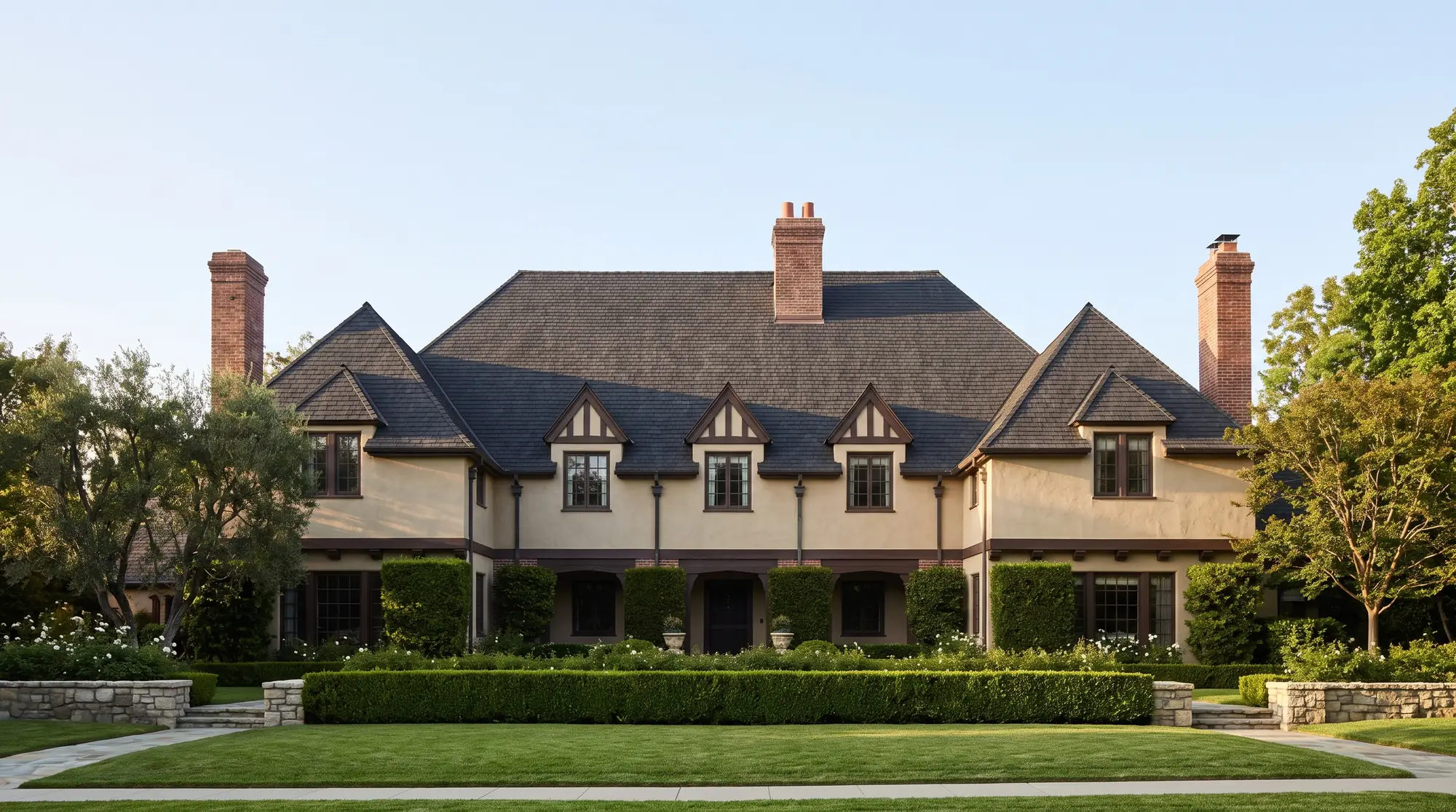
Most cities tell you a roof needs a permit and leave it there. San Marino publishes a list of the roof materials and colors you may use, ties several of them to the style of your house, and writes the installation details into the same document — how the valleys are finished, what the ridge caps look like, what happens at the rake. Pick something on that list and you go straight to a building permit. Pick something off it and a committee of your neighbours looks at your roof first.
How we match you with a San Marino roofer
We're not a roofing company. We hold no contractor's licence and do no roofing work. What we do is find you someone who does, and check them first.
Tell us the address, what the house is — Spanish, Tudor, Colonial Revival, ranch — and what's going on. We match you with one licensed, insured roofing contractor who works in San Marino. Not a list, not five companies calling you at dinner. You get their CSLB licence number before they turn up, so you can check it on the state register yourself. They come out, look at it properly, and give you a written quote. Free, no obligation. If they're not the right fit, say so and we'll re-match you at no cost.
Beyond the licence and the insurance, what we filter for here is whether the contractor has been through this city's process before.
What San Marino's housing stock means for your roof
San Marino incorporated in 1913, and most of it was subdivided and built through the 1920s and 1930s around Huntington Drive and the Huntington grounds. Lacy Park — Wilson Lake until the city bought the land in 1925 — sits in the middle of it. Building carried on eastward through the 1940s and 1950s, and by the end of that the city was full. The county's median build year of 1965 tells you very little here.
- Tile doesn't fail at the tile. Clay barrel and flat concrete tile fail at the underlayment beneath. Tile lasts fifty years or more; the underlayment rarely gets past twenty-five or thirty. That's why a San Marino tile roof can be leaking badly and still look perfect from Oak Grove Avenue.
- The rooflines are cut up. Two-storey period-revival houses on large lots mean dormers, hips, turrets, gable meeting gable, and slate on some of the grander houses along Old Mill Road. Valleys and flashings, not fields of shingle, are where these roofs go wrong — and the oaks that gave Oak Grove its name keep them loaded with debris.
- Age caught up with the second roof, not the first. Almost none of this covering is original. Most was replaced once, much of it in the 1990s, and a thirty-year shingle laid in 1994 is finished.
The list that decides what goes on your roof
The document is the City of San Marino's Pre-Approved Roof Materials, Colors, and Applications List, adopted as Exhibit A to San Marino Planning Commission Resolution Nos. PCR 10-03 and PCR 24-05 and last amended August 28, 2024. You'll find it on the city's permits and forms page at sanmarinoca.gov/services/permits_and_forms.php, listed there as the Pre-Approved Roof Materials Colors and Application List (Adopted August 2024). It's short. Read it before you take a single quote.
The rule at the top is simple. Materials and colors on the list are pre-approved for issuance of a building permit for structures in the residential and commercial zones — the shopfronts on Huntington Drive and Mission Street as well as the houses. Re-roofing with anything not on the list is permitted only if approval is first obtained from the Design Review Committee or the Planning Commission. The DRC is a committee of San Marino residents appointed by the City Council, so a committee of your neighbours looking at your roof is not a figure of speech here. It meets on a published schedule — ask the Community Development Department when it next sits and what the submittal deadline is rather than assuming, because that calendar sets your start date.
What's on the list, in outline:
- Mission clay tile, two-piece barrel, in red tones — only on Spanish or Mediterranean architecture as the city's Residential Design Guidelines define it.
- Natural slate in slate gray — only on Tudor architecture, and it has to go on with random-width tiles.
- Simulated slate and simulated wood shake from named manufacturers in named colors, the shake products limited to Monterey Period Revival, Colonial Revival, Neoclassical, Tudor, Ranch, Cape Cod and Minimal Traditional houses.
- Tar and gravel, or natural wood shake, only where the building already carries a permitted roof of that kind — wood shake then needs a minimum Class A underlayment under a Class A or Class B treated shake.
- Composition fiberglass shingle, a short set of named products and colors, and only where the house meets one of three qualifying conditions.
Two clauses catch people out. Anything over six pounds per square foot — real clay tile, all natural slate — needs structural calculations. And if you change material on the main house, the garage and other accessory structures have to be re-roofed to match, at the same time or within a timeframe the Community Development Director approves.
What your quote has to say in San Marino
The composition shingle entry carries prescriptive installation requirements you can hold a written quote against:
- All valleys shall be cut, not woven, and valley flashing shall be installed. A quote offering woven valleys is telling you the contractor hasn't read the list.
- Low-profile hip and ridge caps on all hips and ridges. The chunky high-profile cap that gets upsold as a premium finish elsewhere isn't allowed here.
- Gutters must be installed to screen the eave edges, ninety-degree edge rakes are not permitted, and staff inspection may be required before the permit issues.
Slate and some of the simulated shakes carry their own detail: a one-inch random stagger, half-inch keyway spacing, edges finished the way a real shake edge sits. None of it is difficult for a contractor who works here. It's just specific. Ask whoever quotes your house to name the material and color exactly as they appear on the list, and to put in writing how they're handling valleys, ridge and rake.
Roofing work commonly needed in San Marino
- Tile lift and relay. Sound tiles come off, old underlayment is stripped, new goes down, the same tiles go back. Because you're re-using the tile you aren't changing material, which keeps design review off the table entirely.
- Rain-season leak repair, October to March — nearly always flashing: chimneys, valley metal, skylight curbs, a perished pipe boot.
- Tile and slate repair, including matching a profile nobody makes any more.
- Composition shingle replacement on the ranch and Minimal Traditional houses in the eastern part of the city.
- Flat and low-slope sections over rear additions, sun rooms and garages, and re-roofing ahead of solar.
There's more on the roof repair and roof replacement pages.
What roof work costs in San Marino
These are estimate ranges for Los Angeles County, not quotes. Nobody can price a roof without standing on it.
- Small repair — slipped tiles, resealing a vent, clearing a drain: roughly $400 to $900. Single-source leak — chimney or skylight flashing, a flat-roof seam: roughly $800 to $2,500.
- Sectional lift and relay, new underlayment under one tile slope: commonly $2,500 to $7,000.
- Tile lift and relay: roughly $12,000 to $30,000. New tile throughout: roughly $25,000 to $60,000 and up.
- Composition shingle replacement: roughly $9,000 to $25,000. Flat or low-slope: roughly $12,000 to $30,000.
- Solar panel removal and reinstall: roughly $4,000 to $10,000, on top of the roof itself.
San Marino sits in the upper half of those ranges more often than the flatlands do. Tile is heavy and slow, the rooflines are complicated, and a material that has to clear the Design Review Committee costs money before anyone climbs a ladder. Fuller breakdown on the roofing costs page.
Permits and code in San Marino
San Marino is not LADBS, and it isn't Pasadena either. It sits right against Pasadena's southern edge and still runs its own Community Development Department, planning and building together. The permit comes from the city, and your contractor should pull it under their own licence. If a roofer asks you to take out an owner-builder permit instead, stop and ask why. Ask the department what the current permit fee and review timeline are when you apply — both are worth confirming rather than assuming.
Landmarks and the Mills Act
San Marino adopted a historic preservation ordinance in 2018 and completed a Citywide Historic Resources Survey in 2020. If your house is a designated landmark, exterior work — roofing included — needs a Certificate of Appropriateness first. The city also runs a Mills Act programme, trading tax relief for maintaining a historic building's character, and a roof is part of that character. Same mechanism the Pasadena page describes, same upshot: review before permit. The survey matters even if you're not designated — one qualifying condition for composition shingle turns on whether your house is identified as individually significant in it.
Fire zones, honestly
Most of San Marino is flat valley floor, and this is not the foothill situation described on the Altadena page. Your roofer shouldn't be quoting fire-zone assemblies unless your particular parcel calls for it. CAL FIRE released the final Southern California phase of its updated hazard maps on 24 March 2025, so check your own address if you want certainty. What January 2025 did leave across this side of the valley was ash, and a valley packed with debris will back water under the flashing the first time it rains.
Your matched contractor's licence
Every contractor we match you with holds a current CSLB licence — a C-39 roofing licence, or a B general building licence where the roof sits inside a larger job — and carries liability insurance and workers' compensation cover. We check both before your details go over, and you get the licence number up front so you can verify it yourself in a minute: status active, name matching the name on your quote, classification covering roofing, workers' comp on file or a valid exemption, bond current.
To be clear about who is who: your contract is with the roofing contractor. Any workmanship guarantee, and any manufacturer's material warranty, comes from them — not from us.
Common questions about roofing in San Marino
Can I re-roof in whatever material I like?
No. If the material and color are on the city's pre-approved list and your house qualifies for it, you go straight to a building permit. If not, you need approval from the Design Review Committee or the Planning Commission first, and that review can attach conditions covering color, how the material suits the house, and installation.
My tiles look perfect. Why would I need a roof?
Because clay and concrete tile outlive the underlayment beneath them by decades. A lift and relay re-uses your tiles and replaces the layer that actually keeps water out — and since the material doesn't change, design review never arises.
Do I need a permit, and who issues it?
Yes, and the City of San Marino issues it — not LADBS, and not Pasadena, even though you're minutes from both. Your contractor pulls it under their own licence.
How do I know whether my house is a designated landmark?
Ask the Community Development Department. Designation is separate from the 2020 survey, so appearing in the survey isn't the same as being designated — but both can affect what's allowed on the roof.
When should I book the work?
Late spring through early autumn, ahead of the October to March rain rather than chasing it. If your material needs Design Review Committee approval, ask the Community Development Department for the committee's meeting dates and submittal deadlines and build them into your timeline.
Tell us what's going on with your roof and we'll match you with one licensed San Marino roofer, licence number up front. Start here. Nearby: Pasadena and Altadena.