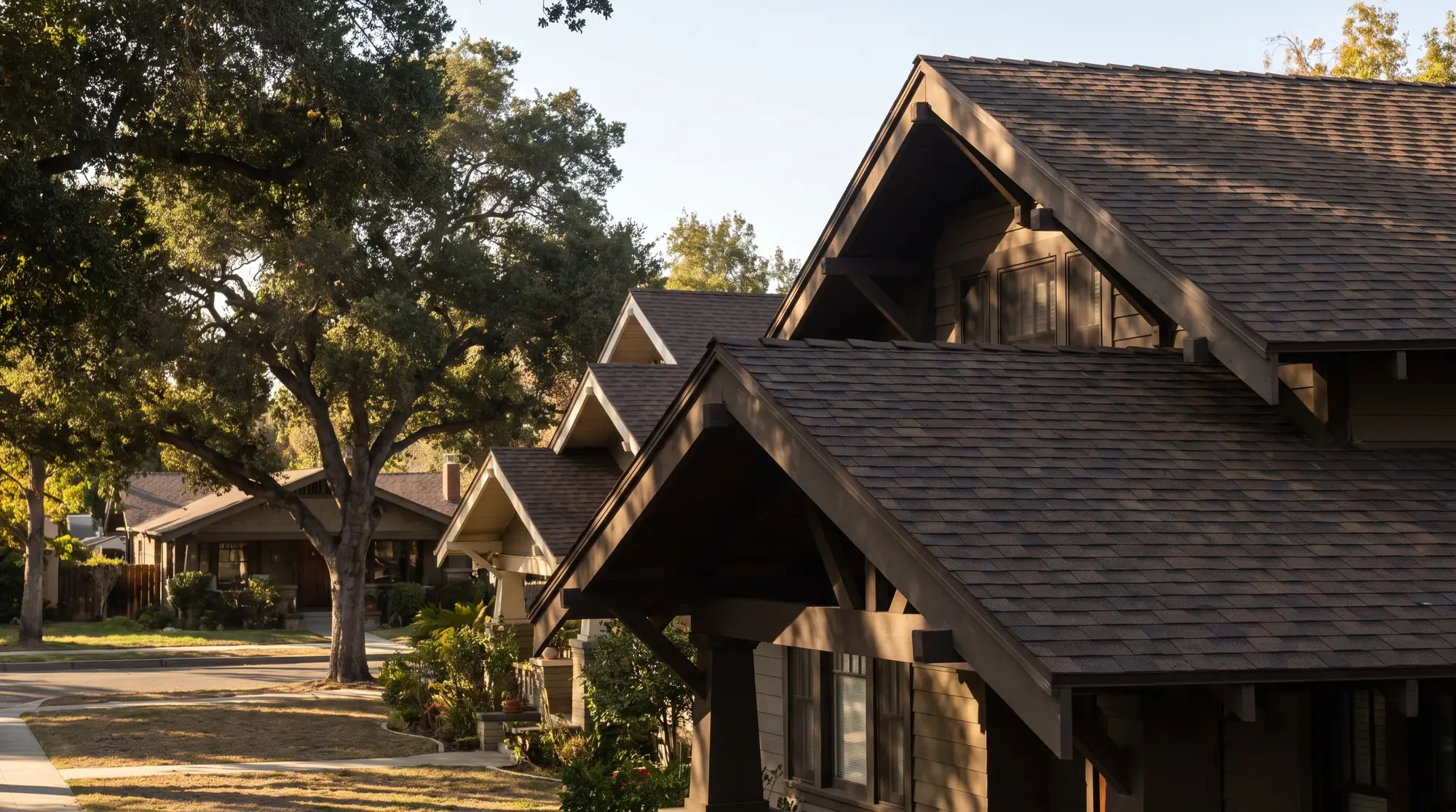
Pasadena has some of the oldest housing in Los Angeles County, and a lot of it sits under clay or concrete tile. That changes nearly everything about a roofing job here — what fails first, what it costs to put right, and who signs off on the work. The city runs its own building department rather than going through LADBS, and if your house is a landmark or sits in a landmark district, Pasadena has a say in what goes back on the roof.
How we match you with a Pasadena roofer
We're not a roofing company, and that's the point. We hold no contractor's licence and do no roofing work. What we do is find you someone who does.
Tell us the address, what's going on, and roughly when you'd like it looked at. We match you with one licensed, insured roofing contractor who already works in Pasadena — not a list to chase, one name. You get their CSLB licence number before they turn up, so you can check it on the state register yourself. They come out, look at it properly, and give you a written quote. It's free, with no obligation.
If they're not the right fit — wrong material, wrong timing, or you just didn't warm to them — say so and we'll match you with someone else at no cost. The work, the quote and any warranty belong to the contractor, not to us.
What Pasadena's housing stock means for your roof
Los Angeles County's median home was built in 1965. Pasadena's is older, and in several neighbourhoods older by decades. The city built out early: Craftsman bungalows from the 1900s to the 1920s in Bungalow Heaven and Garfield Heights; Spanish Colonial Revival through the 1920s and 30s in Madison Heights and along the Oak Knoll corridor; post-war ranch tracts in Hastings Ranch and east Pasadena; mid-century modern on the San Rafael and Linda Vista hillsides. Three things follow from that.
- Almost none of these roofs are original. Much of Pasadena's early stock was laid in wood shake, long since gone. Most of these houses were re-roofed once, a lot of it in the 1990s — and a thirty-year shingle laid in 1994 is finished. Age-out replacement is the biggest single reason people here go looking for a roofer, and the least talked about.
- Tile is everywhere, and tile doesn't fail at the tile. Clay barrel and concrete tile roofs fail at the underlayment underneath. The tile itself can be sound at eighty years old while the felt below it has turned to dust. That's why a tile roof can leak badly and still look perfect from the street.
- Craftsman detailing is leak-prone by design. Deep overhangs, shallow pitches, dormers and porch roofs tying into a main slope — every junction is a place water can find. Valleys and flashings, not fields of shingle, are where Pasadena roofs usually go wrong.
Add the trees. Pasadena's mature deodar cedars, oaks and sycamores drop a steady load into valleys and gutters, and the foothills pick up more rain in a wet winter than the basin does. Debris holds water against the flashing, and it finds its way in.
Roofing work commonly needed in Pasadena
- Rain-season leak repair, October to March. Almost always flashing: chimneys and parapets, valley metal, skylight curbs, or a pipe boot perished in the sun.
- Tile lift and relay. Sound tiles come off and are stacked, old underlayment is stripped, new underlayment goes down, same tiles back. On a Spanish-tile house this is the right call more often than people expect, and far cheaper than new tile throughout.
- Composition shingle replacement. The volume job — straight age-out on 1990s roofs.
- Low-slope and flat sections. Porch roofs, rear additions and whole mid-century hillside houses — TPO, modified bitumen or cap sheet. Ponding water and failed seams are the usual complaints.
- Solar re-roofs — panels come off before a re-roof and go back after — and Chapter 7A fire-zone upgrades on the city's north and east edges.
What roof work costs in Pasadena
These are estimate ranges for a typical Pasadena single-family house, not quotes. Nobody can price a roof without seeing it — the written quote is the real number.
- Composition shingle replacement: roughly $9,000 to $25,000.
- Tile lift and relay: roughly $12,000 to $30,000.
- New tile throughout: roughly $25,000 to $60,000 and up.
- Flat or low-slope (TPO, modified bitumen, cap sheet): roughly $12,000 to $30,000.
- Solar panel removal and reinstall: roughly $4,000 to $10,000, on top of the roof itself.
Pasadena sits in the upper half of those ranges more often than the flatlands do, for local reasons. Tile is heavy and slow to handle. Hillside houses in Linda Vista and above New York Drive are awkward to stage. Two-storey Craftsmans with complicated rooflines take longer than a simple gable. And matching historic tile on a designated property costs money before anyone climbs a ladder.
Permits and code in Pasadena
Pasadena is not LADBS. The city runs its own Building and Safety division out of its permit centre on North Garfield Avenue, and a re-roof needs a permit from the city. Your contractor should pull it under their own licence. If a roofer asks you to take out an owner-builder permit instead, that's a reason to stop and ask why. Two local things catch people out.
Fire hazard zones in the foothills
The northern and eastern edges of the city — the streets running up toward the Angeles National Forest, the Chaney Trail side, Kinneloa and the upper reaches of Hastings Ranch — fall in fire hazard severity zones. There, Chapter 7A of the California Building Code applies, and it requires a Class A roof assembly. That is earned by the whole build-up — deck, underlayment, cap sheet, valley metal, and how edges and penetrations are detailed — not by the shingle alone. A Class A shingle over the wrong underlayment is not a Class A assembly. Chapter 7A also covers ember-resistant attic vents and non-combustible gutters.
Landmarks, landmark districts and the Mills Act
Pasadena runs one of the largest historic preservation programmes in California, including a very active Mills Act programme that gives property tax relief in exchange for maintaining a historic building's character-defining features. A roof is a character-defining feature.
If your house is a designated landmark, or a contributing property in a landmark district, exterior changes visible from the street generally need a Certificate of Appropriateness from the city's historic preservation staff before work starts. In practice you usually cannot swap clay barrel tile for composition shingle, or a period profile for whatever's cheapest on the truck. The timeline is longer too, because that review comes before the permit. And if you hold a Mills Act contract, an unsympathetic replacement roof can put the contract itself at risk.
None of that makes the job impossible. It makes it a job for a contractor who has been through Pasadena's process before — which is part of what goes into the match.
Your matched contractor's licence
Every contractor we work with holds a current Contractors State License Board licence and carries insurance, and both are checked before they get your details. Roofing is normally done under a C-39 roofing classification, or by a B general building contractor. You get the CSLB number up front, before anyone comes to the house, so you can look it up on the state register. Worth confirming:
- The status reads active, and the name matches the name on your quote.
- The classification covers roofing.
- Workers' compensation is on file, or a valid exemption is.
- The bond is current.
Any workmanship guarantee is the contractor's, given in writing on their own paperwork. Read it before you sign, and ask what it covers and for how long.
Common questions about roofing in Pasadena
Do I need a permit to re-roof a house in Pasadena?
Yes, and from the City of Pasadena's own Building and Safety division — not LADBS, even though your house is in Los Angeles County. Your contractor pulls it.
My house is in a landmark district. Can I change the roof material?
Usually not freely. Landmarks and contributing properties typically need a Certificate of Appropriateness for visible exterior changes, and roof material is exactly what that review looks at. Ask the city's preservation staff before committing to a material, and budget extra time.
My tile roof is leaking. Do I have to replace the whole thing?
Often not. If the tiles are sound, a lift and relay — tiles off, new underlayment, same tiles back — solves the actual problem at a fraction of the cost of new tile. A contractor who reaches straight for full replacement without assessing the tile should be asked to explain why.
I'm putting solar on. Should I do the roof first?
If the roof is fifteen years old or more, yes. Taking panels off and putting them back later runs roughly $4,000 to $10,000 on top of a re-roof you could have done first. In a county whose median home dates to 1965, that catches most people.
How do I know if my street is in a fire hazard zone?
The foothill edges are; most of the flat central and south city isn't. The city and CAL FIRE both publish the mapped zones, and Building and Safety will confirm a specific address. It decides whether Chapter 7A's Class A assembly, ember-resistant vent and non-combustible gutter requirements apply to your job.
Ready to get it looked at? Tell us what's going on and we'll match you with one licensed Pasadena roofer, licence number up front. There's more on roof repair, roof replacement and roofing contractors in Altadena.