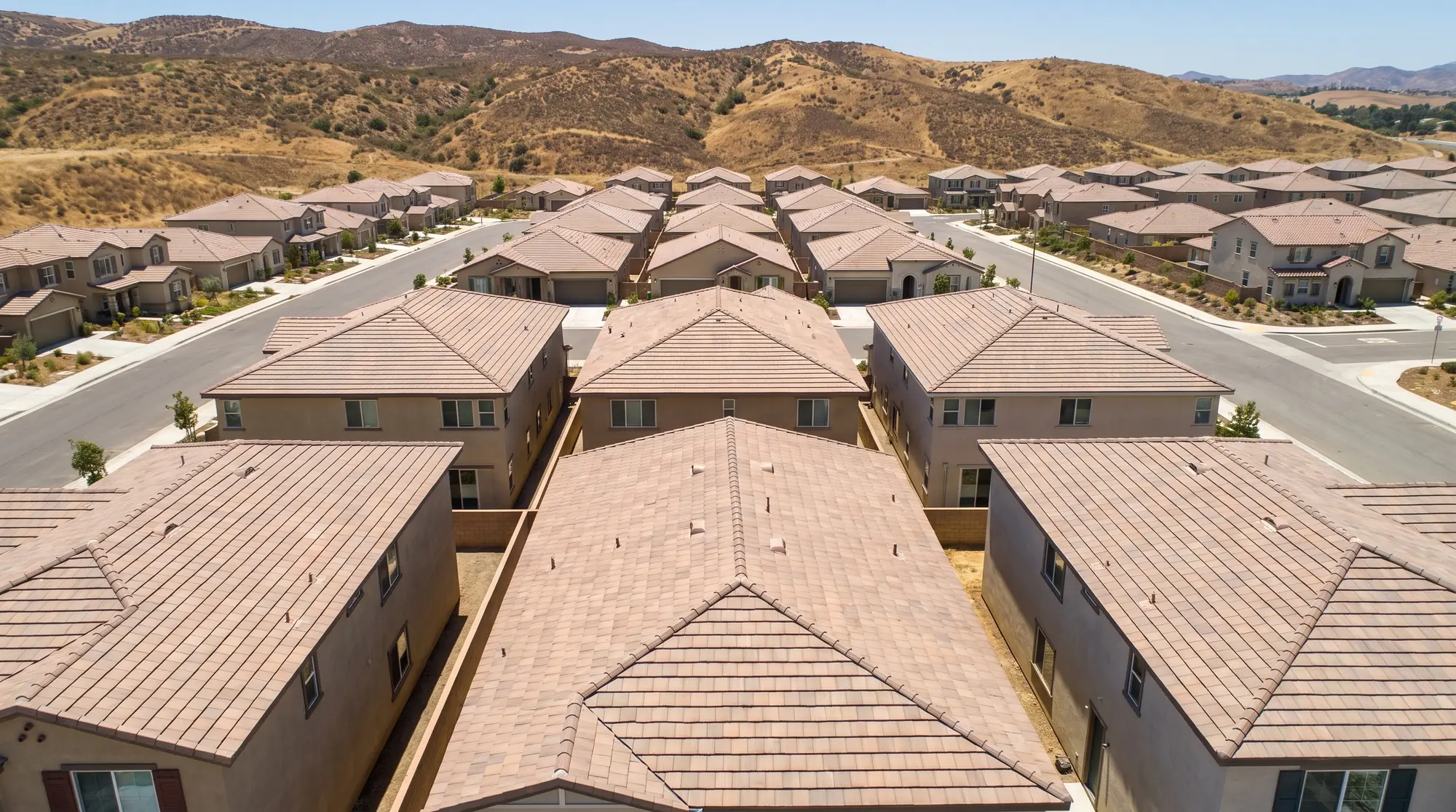
Roofing advice for Los Angeles County starts from the same fact every time: the median home here went up in 1965. In Santa Clarita that describes hardly anything. On Census ACS 2024 five-year estimates only about 4% of its housing predates 1960, and about a quarter of it went up in the 1980s, the single biggest decade in the city's housing stock. The city only incorporated on 15 December 1987, pulling Valencia, Saugus, Newhall and Canyon Country together. So the problem here isn't a 1920s bungalow or a 1950s tract. It's concrete tile laid in the 1980s and 90s, on felt that has run out of years.
Two other things shape a job here. Most of these neighbourhoods are HOA-governed, so the tile color needs a board's approval as well as a permit. And the city boundary is jagged: Stevenson Ranch, Castaic, Val Verde and Agua Dulce all read as Santa Clarita on an envelope, and none of them are in the city.
How we match you with a Santa Clarita roofer
We're not a roofing company. We hold no contractor's licence and do no roofing work. We find you someone who does, and we check them before your details go anywhere.
Tell us the address, the roof type if you know it, and what's going on. We match you with one licensed, insured roofing contractor working in Santa Clarita. One name, not a list, and not five companies ringing you at dinner. You get their CSLB licence number before they arrive, so you can look it up on the state register yourself. They come out, get on the roof and into the attic, and give you a written quote. Free, no obligation, and we'll re-match you at no cost if they're not right. For this city we want people who do a lot of tile work, and who are used to submitting to an HOA architectural committee as well as pulling a permit.
What Santa Clarita's housing stock means for your roof
Valencia, Saugus, Newhall, Canyon Country, Plum Canyon, Sand Canyon: master-planned tract after master-planned tract, built out from the 1970s through the 2000s, and a great deal of it roofed in concrete tile. Around 72% of the city's roughly 75,800 occupied homes are owner-occupied, high for this county — Santa Monica sits at 27.9% — so the person deciding about the roof is usually the person still living under it in ten years.
Concrete tile suits this valley. It's Class A on its own and it takes the inland heat and UV far better than shingle. Which is why the failure catches people out. Tile doesn't fail at the tile. The tile is a rain hat. The layer keeping water out of your house is the underlayment beneath it, and on a roof laid in 1988 or 1994 that's asphalt-saturated felt. Tile lasts fifty years or more; the felt under it rarely gets past twenty-five or thirty.
So a Valencia tract finished in 1988 is thirty-eight years old, and a Plum Canyon house from 1994 is thirty-two. Both are past the window where tile underlayment gives out, and because these streets went up all at once they arrive there all at once. What you see is a ceiling stain after the first real rain with no cracked tile above it, rusted valley metal, ridge mortar crumbling onto the tile below, or a line of broken tiles where a satellite installer walked without knowing how to move on tile. The roof looks immaculate from the street the whole time.
Which makes the most useful question a short one: is my tile sound? If it is, you don't need new tile. You need the same tile back down over new underlayment. Anyone quoting a whole new tile roof without first telling you what condition your tile is in should be asked, plainly, why.
Roofing work commonly needed in Santa Clarita
- Tile lift and relay. The signature job here. Sound tiles come off and are stacked, old felt is stripped, new underlayment goes down, the same tiles go back.
- Underlayment-driven leak repair through the October to March rain season, where a relay isn't affordable yet and the leak needs stopping now.
- Ridge and hip re-bedding, flashing and valley metal, and broken tile replacement after foot traffic. Usually done as part of the relay.
- Composition shingle replacement on the tracts that were shingled rather than tiled, and on garage and patio additions.
- Re-roofing before solar, or taking an existing array off and putting it back.
- Class A assembly work on canyon-edge parcels inside a very high fire hazard severity zone.
There's more on the roof repair and roof replacement pages.
What roof work costs in Santa Clarita
These are estimate ranges for Los Angeles County, not quotes. Nobody can price a roof without standing on it.
- Tile lift and relay: roughly $12,000 to $30,000. One slope alone, commonly $2,500 to $7,000.
- New tile throughout: roughly $25,000 to $60,000 and up.
- Composition shingle replacement: roughly $9,000 to $25,000, or around $8 to $12 a square foot installed.
- Single-source leak repair, chimney or skylight flashing: roughly $800 to $2,500. Resealing a vent or resetting slipped tiles, about $400 to $900.
- Rotten decking, found once the tile is off: commonly $70 to $100 a sheet installed.
- Solar removal and reinstallation: roughly $4,000 to $10,000, on top of the roof.
Santa Clarita sits mid-range. Simple tract roof shapes and wide driveways help; tile is heavy and slow to handle, plenty of houses are two storeys, and canyon lots add hours. Roof area is bigger than people expect, too — a square is 100 square feet, add 10% to 30% for pitch, and a 1,600 square foot single-storey house is often 18 to 20 squares.
The comparison that matters here is relay against replacement. A relay buys another twenty-five or thirty years out of tile you already own, and new tile starts where the relay range ends. If your tile is sound, the second quote is largely paying to throw away a material with decades left in it.
Permits and code in Santa Clarita
The city has its own building department, and a lot of the valley isn't in the city
The City of Santa Clarita Building and Safety Division permits and inspects re-roofs inside the city limits. Not LADBS, not the county. But Stevenson Ranch, Castaic, Val Verde and Agua Dulce are unincorporated Los Angeles County, so those permits go to County Public Works, Building and Safety, the same department that handles Altadena. Ask which counter your contractor is pulling the permit at. Pulling it is their job, and anyone offering to skip it has told you something useful.
What the city's re-roof rules actually say
The city publishes its residential re-roof requirements, and they're more specific than most cities bother with. Confirm the current sheet, since the code cycle turns over every three years.
- A permit and an onsite pre-inspection before work starts, and again once the old covering is off so an inspector can check the deck and framing. Repairs under 10% of the roof area, or 200 square feet, whichever is less, generally don't need one — and that's your allowance for the whole year, not per job.
- Existing clay or concrete tile has to come off rather than be roofed over, as does any roof already carrying two or more layers. That's the code describing a lift and relay: sound tile is allowed back on, cracked tile is not.
- Weight is a constraint. The city's re-roofing handout puts the ceiling at 7 pounds a square foot for the finished roof, and it can also ask for structural calculations any time the new roof simply weighs more than the one that came off, even under that number. Either way it's a licensed engineer or architect who has to do them. New plywood counts toward the 7 pounds too: 15/32-inch adds about 1.5 on its own. All of which catches anyone wanting to swap shingle for tile.
- Wood shakes and shingles are a hard conversation. The city's own re-roofing handout says they aren't permitted, fire-treated or not, and inside the fire hazard zone the wildland-urban interface rules put a Class A assembly out of reach for them anyway. The current code amendments don't restate that ban in so many words, so if you have your heart set on wood, ask Building and Safety before you order anything.
Fire zones, and what Class A actually means
Real parts of this valley sit in a very high fire hazard severity zone: the canyon edges above Sand Canyon and Placerita Canyon, the ground running toward the Angeles National Forest, the slopes toward the Santa Susanas. CAL FIRE released the final Southern California phase of its redrawn maps on 24 March 2025, and more ground is inside the lines than before, so check your own parcel on the state's viewer.
Inside the zone, Chapter 7A applies and the roof has to be a Class A assembly — the whole tested build-up, deck through covering, including how valleys, edges and penetrations are detailed. Concrete tile is Class A by itself, which helps, but the assembly still needs the right underlayment, closures at eave and ridge so embers can't get under the tile, ember-resistant vents and non-combustible gutters. Two quotes that both say Class A can be very different roofs. Outside the zone the city still sets a Class B minimum.
Your HOA is a second approval, on a separate clock
This is the part that costs people weeks. Most of the master-planned communities here, across Valencia, Saugus, Canyon Country, Newhall and over the line in Stevenson Ranch, have an architectural committee controlling roofing material, profile and color. A permit says the roof is safe and legal. It says nothing about whether your board will accept the blend.
Put the HOA submittal in the same week as the permit application, not after it. Committees generally meet monthly, so missing one costs a month whatever the city has approved. California's Davis-Stirling Act requires an association to run a fair, reasonable and expeditious review, to state a maximum response time in its own governing documents, and to give reasons in writing if it says no, so read those documents and you'll know the real deadline. Ask the roofer for the package up front: data sheet, profile and color blend name, a sample if the board wants one, licence and insurance certificates. One quiet advantage of a relay is that the tile going back on is the tile the board already approved.
Your matched contractor's licence
Every contractor we match you with holds a current Contractors State License Board licence and carries insurance, and we check both before your details go over. Roofing is done under a C-39 roofing classification, or a B general building licence where the roof sits inside a larger job. You get the number up front, so you can confirm on the register that the status reads active, the name matches your quote, the classification covers roofing, workers' compensation is on file or a valid exemption is, and the bond and liability cover are current.
Your contract is with the contractor. The work, the workmanship guarantee and the manufacturer's material warranty all belong to them, not to us.
Common questions about roofing in Santa Clarita
My tile looks perfect. Why would anything be wrong?
Because tile outlives the underlayment beneath it by decades, and the underlayment is the part keeping water out. On a house roofed in the late 1980s or the 1990s, the felt is well past the twenty-five to thirty years it's good for.
Lift and relay, or a whole new tile roof?
It depends on your existing tile. If it's sound, a relay reuses it and replaces the layer that failed, at roughly $12,000 to $30,000 rather than $25,000 to $60,000 and up. If the tile is spalling or cracking on its own, replacement is the honest answer.
Do I need a permit for a small repair?
Generally not for work under 10% of the roof area or 200 square feet, whichever is smaller, inside the city — and that's the allowance for the whole year, not for each job. Anything larger needs a permit and a pre-inspection. In Stevenson Ranch or Castaic the county's rules apply instead.
Do I need HOA approval as well as a city permit?
In most of these communities, yes, and the two run independently. Submit both in the same week. An approved permit doesn't help if the committee turns down the color.
When's the best time to do this?
Late spring through early autumn. Crews are less stretched, the weather is dry, and you're ahead of the October to March rain rather than chasing it.
Tell us what's going on with your roof and we'll match you with one licensed Santa Clarita roofer, licence number up front. There's more on roof replacement, what roofing costs in Los Angeles and roofing contractors in Glendale, or get a free quote when you're ready.